

1. Introduction
MP For A Week is a multi-level online game aimed for use in the classroom that simulates a week as an elected representative in the UK Parliament. Players are presented with numerous tasks and choices, take responsibility for their decisions, and see the implications of their actions on their careers as Members of Parliament (MPs). The drama is presented in an ever-changing environment, offering a diverse blend of strategy and experimentation, together with a high level of personalisation. A positive overall rating as a politician is the ultimate goal for players of the game.
 Fig 1: MP For A Week http://www.parliament.uk/mpforaweek
The resource was created by the UK Parliament’s Education Service as part of its remit to support young people's understanding of Parliament and democracy. It took a year to create and was launched in January 2010. One year on, it has won four educational awards, received over 125,000 visits, and become a valued resource for teachers, students and MPs. This paper, written to accompany a demonstration session at the Archimuse Museums and the Web Conference 2011, summarises the story so far, including details of the challenges faced, the user-centred design approach, lessons learned, and next steps.
2. About Parliament’s Education Service
Parliament’s Education Service works on behalf of both the House of Commons and the House of Lords to:
- inform young people about the role, work and history of Parliament
- engage them to understand the relevance of Parliament and democracy today, and
- empower them to get involved by equipping them with the knowledge and skills to take part.
We produce a range of online and offline resources, run school visits to Parliament (including tours of the historic Palace of Westminster and interactive workshops), offer teacher training and an outreach programme, and organise competitions and events.
 Fig 2: Parliament’s Education Service homepage
On projects such as MP For A Week, we run a procurement process to find expert suppliers to work with us to deliver our objectives. In this case, Lightbox Education, a UK company specialising in providing online educational games and applications, won the contract.
3. The challenge: engaging young people with politics and Parliament
Our starting point for the project was to understand the challenges that educators face when teaching about democracy, Parliament and politics.
Young people are extremely interested in issues that affect them. They are motivated and passionate about trying to change their world for the better – but many don’t see the link with politics. Indeed, many young people in the UK are turned off by politics. They find it dull. They perceive Parliament and government as being distant from them and believe they can do little to affect how their country is run. Levels of understanding amongst young people about the role of MPs and Members of the House of Lords are low.
Furthermore, the UK Parliament is based in the world-famous Palace of Westminster. The grandeur of the building, its history and its collections, although awe-inspiring, can add to the sense of distance between politicians and the public, and detract from its modern-day functions.
The challenge for the Education Service is to break down these perceived barriers between Parliament and young people, and show how politics affect them and how they can affect politics. The aim is to make Parliament and politics familiar, and arm young people with the skills and knowledge to become active citizens - to influence decisions and get their voices heard.
4. The vision: learning by doing
The learning objectives we wanted to meet included not only what MPs do, but also the tensions and choices that exist when making decisions, the ability to weigh-up different viewpoints, to prioritise and to think critically. All these skills chimed well with a simulation game where the players took on the role of an MPs. Players would learn on the job how laws are made, how the government is held to account, and how MPs represent their constituents.
In addition to our core learning outcomes for the resource, our intention was that a games-based approach could initiate a change in attitudes and values. We wanted to surprise the audience by sparking an enjoyment of politics.
5. Development: embracing user-centred design
Student input
Very early on in the development we wanted to know exactly what the target audience of 11-16-year-olds thought of our game idea. We arranged three user-centred design sessions with school students to gain their expert guidance in creating the game.
Students tested content ideas, usability and the visual style. We identified topics of interest by asking them to rank current issues that they felt most strongly about. Through mocked-up screen layouts, we found that the proposed designs for the progress meter and scoring display needed simplifying. We also changed our original cinematic, photo-realistic look and feel to incorporate an illustrated, animated style that was extremely popular with the users.
This blended visual approach incorporated students’ feedback and our desire to use photographs of the inside of the Palace of Westminster to break down some of the barriers presented by the building itself, and also to exploit the excitement of walking through the corridors of power. The photo-realistic and illustrated combination gave us the best of both worlds, and users reacted to it very positively.
Other stakeholders
In addition to student input, we captured the requirements of teachers and MPs themselves. The teachers we spoke to suggested ways in which they’d use the resource in the classroom, identifying support materials and functionality that would assist them. Consultation with MPs was vital because there is no job description for their profession, with different Members approaching the role in different ways. Member input enabled us to portray a real sense of the competing demands they face, the range of people they meet, and the breadth of topics they address.
6. The product: a multi-leveled simulation game engine
Game overview
The players start on Monday morning and must make it through to Friday evening without letting their scores drop too low. Each day contains 12 working hours. The players choose the type of activity they want to complete from a smart-phone menu. Some activity types are not available through the menu; instead, they are pushed to the player at specific points in the game.
Players receives a score after completing each activity, and this is added to their cumulative score for the week. Each activity takes a pre-determined amount of time in the day. As the week progresses, further activities become available and there is more to do than time allows, forcing the players to prioritise.
Activity types
The activities in the game deliver learning outcomes in different ways, including through knowledge and action. Where the action is not delivering a substantive learning point (e.g. the ‘catching the Speaker’s eye’ mini-game), it is delivering a game-play element that encourages motivation and adds to the overall narrative of the experience.
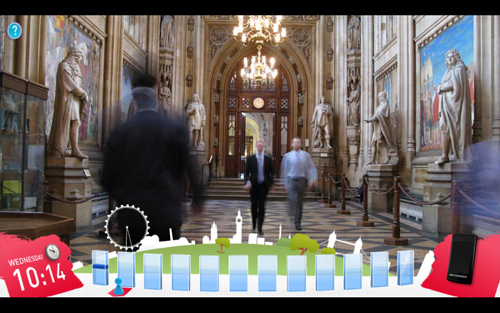 Fig 3: MP For A Week activity selection screen
There are seven distinct types of activity available in the game:
- Preparing and making a speech for the House of Commons Chamber. Players must choose the most appropriate sentences from a bank of speech clips, and arrange them in a sensible order. Users can boost their debate score by playing a mini-game where they must ‘catch the Speaker’s eye’ in the Chamber.
- Attending meetings and events. Players are dropped into scenarios where they must choose between conflicting commitments, which might include meeting with constituents, ministers, campaign groups and the press.
- Dealing with correspondence. Players must choose the most appropriate response to tricky dilemmas and questions from voters, colleagues in Parliament and the media.
- Taking part in a press conference. Players can boost their media rating in this mini-game by fending off a baying pack of journalists.
- Asking parliamentary questions. Players must choose the best question to scrutinise the work of government ministers in the Commons chamber.
- Voting on new laws. Players receive a call from the whip explaining the party line on an upcoming vote. The player must choose whether to attend, and if so, which way to vote - ‘aye’ (with the government) or ‘no’ (against the government).
- Checking the work of a government department in select (scrutiny) committees. Players must choose a variety of witnesses to give evidence on a particular topic, ensuring there is a wide range of views and depth of knowledge.
Additionally, players can choose at any point to travel between Westminster and their constituency.
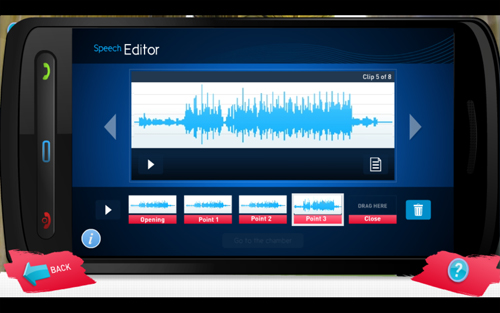 Fig 4: MP For A Week speech-making activity
Content and characters
We wanted to present a credible and intriguing view of the political process, whilst taking on the challenges of making the subject matter interesting and accessible. Finding the right ‘hooks’ to inspire the target audience, together with striking the right tone, was critical to meeting this challenge.
In order to populate the game with characters and content that worked for the learning outcomes for our chosen audience, we imagined a fictional UK society. We attempted to create a world small enough that it felt understandable to a player, but representative enough to feel universal. We chose to weave a limited number of characters, issues and themes throughout the game scenarios to add a sense of story and plot to the experience.
The game world included a set number of government departments and corresponding government ministers, a range of constituents, other MPs and Members of the House of Lords, national and local journalists, lobby groups, and some important votes on legislation coming up.
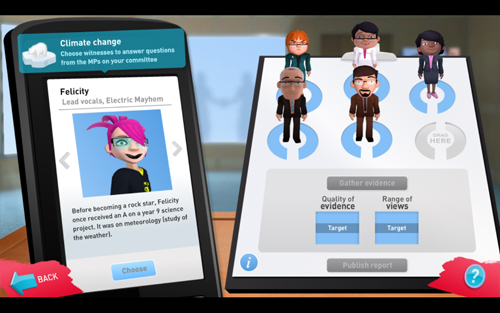 Fig 5: MP For A Week select committee activity
We asked ourselves the following questions when creating content ideas:
- Is it fun and light?
- Is it relevant to the target audience?
- Is it useful for making an educational point?
Inspiration was welcomed, but research was essential. This included quizzing the target audience about their general and political interests, and also looking to other useful sources for ideas, such as school debating websites that identified common subjects. The ‘debatabase’ (http://www.idebate.org/debatabase) was a particularly valuable resource.
Filling the game with enough strong content was particularly challenging and time-consuming, but we felt the effort paid off. It added a real-life feel to the game, and the chance for students to think about the work of an MP with real context – rather than just through the processes of Parliament. This additional layer of content helped to widen the potential learning, and improved students’ ability to see the connections between their society and everyday life, and the work of MPs and the political system.
It was also a challenge to weave together so much content with the educational learning concepts in a creative way. Often the style of presentation on screen created constraints for the written content. We found it invaluable to employ a variety of writing techniques to solve some of these problems, drawing on news-writing, speechwriting, storytelling, copywriting and screenwriting. We even found inspiration on how to create meaningful dilemmas by reviewing ‘choose your own adventure’ books.
Design
We wanted to present an ever-changing, fast-moving environment. We also wanted to exploit the impressive architecture of the Palace of Westminster, but clearly show it to be a working building rather than an antiquity. One way we achieved this was to inject a real sense of drama in the game with exclusive photography of the Palace, allowing the players to chart a route through the ‘corridors of power’ whilst having to carry out the day-to-day work of elected politicians.
This photo-realistic approach was coupled with 3D illustrations of characters and high-quality design for the specific activities. The finished effect presents a blend of drama, realism and friendliness.
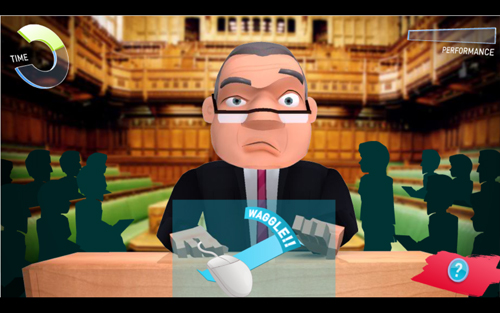 Fig 6: MP For A Week ‘catching the Speaker’s eye’ mini-game
Scoring
In real life, political judgments are often multi-layered, influenced by the facts of the situation, the reactions of those affected, and the ethical perspective of the individual politician. Translating this complexity into a simple scoring system was no easy task.
After consulting with MPs, the guiding principle behind the scoring was that there is no defined ‘correct way’ to be an MP. Players are presented with scenarios in which they are asked to make choices, which then determine a particular set of consequences across three metrics:
- Political party rating
- Local popularity
- Media profile
We deliberately inserted a certain amount of unpredictability into the action, to keep players interested and on their toes. This also simulated a world in which the players are not in total control – they are just one element in a situation with multiple events and scenarios unfolding around them.
Especially in the harder levels, players find that it’s often a case of balancing these three metrics. It is possible for the players to fail the game if any one of the metrics drops too low. At this point, the players must start the week again.
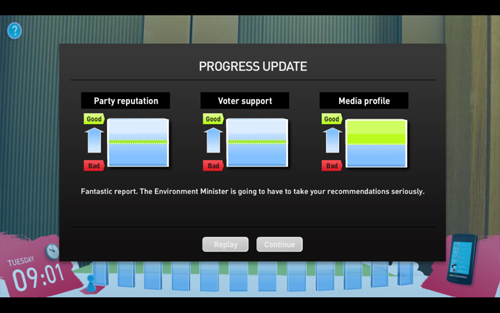 Fig 7: MP For A Week scoring and feedback screen
The balancing of three scores, rather than an overall metric, also allows players to choose, to some extent, their own objectives in the game. For instance, players could choose to be party rebels and stick up for their constituents no matter what. Or they could choose to be totally loyal to their party. Although simplified in the game, these are decisions that real MPs must make. The realisation of the conflicts that sometimes arise between what’s good for the party, what’s good for the local constituents, and what the MP feels is in the national interest, is a worthwhile learning outcome in itself.
We also wanted to embrace the subversive nature of some players. For example, we knew that a small proportion of our audience would have a rebellious attitude to the game and try to do as badly as possible. However, the player still has to think about what choices to make in order to do badly – so the learning is still taking place.
An alternative model of scoring would be to match the players’ choices to a political ideology or political party. This would be difficult to achieve in our simplified version of the world, and, we felt, not the desired focus of the learning in our resource. We therefore needed to ensure that, although our opposition and government had firm differences of opinion, they didn’t accidentally match any specific political party in reality.
Feedback
The feedback a player receives after making a choice is essential in conveying the impact of a decision and the associated learning. Feedback comes in several forms in MP For A Week:
- A small piece of written or audio feedback that informs a player of the outcome of the latest decision just made
- The corresponding change in score
- The player’s cumulative score
- A cartoon sketch of the player’s overall performance at the end of each day
- A warning phone call from the whip character if any one of the three scoring metrics drops dangerously close to the failure point
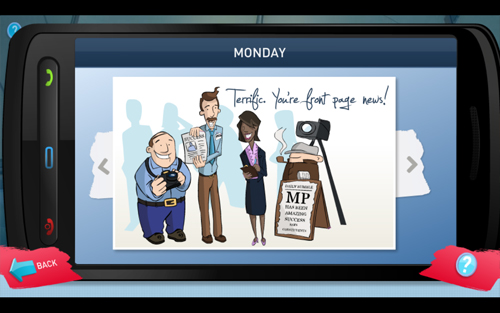 Fig 8: MP For A Week end-of-day cartoon feedback
Personalisation and differentiation
Settings at the start of the game allow a great degree of personalisation and therefore variability in the game:
- Three levels of difficulty allow for differentiation within a class and individual progression. Choices are more complicated in the harder levels, often with no clear ‘right’ answer - reflecting the reality of trade-offs in real-world decision making
- Option to play as a government or opposition MP allows comparison of the job from both sides
- Twelve geographical regions personalise the experience and reveal how location affects an MP’s time management
- Three areas of special interest (global, local and financial) affect the type of content the player faces.
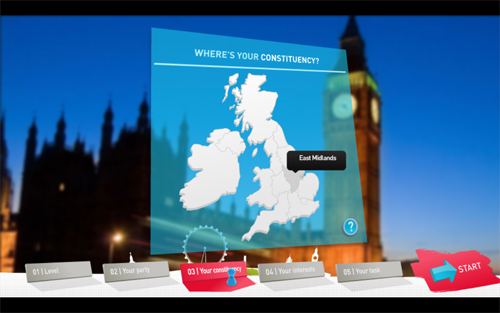 Fig 9: MP For A Week settings screen
A sophisticated game engine retains these details and serves up appropriate individual pieces of content for each activity type chosen. The bank of content contains over 150 individual activities. No game is the same twice, the aim being to encourage re-playability.
Supporting material
MP For A Week was designed to be as flexible as possible in the number of ways it can be used. The modular approach to activities and content allowed us to give teachers special controls for whole class teaching on an interactive whiteboard. Teachers have the ability to go to a special screen and pick individual activities to play in isolation from the game.
For example, a teacher wanting to run a debate in the classroom on environmentally friendly transport can jump straight in to the relevant speech-making activity and ask the class to complete it as a standalone task without playing the rest of the game. The teacher could then carry out a classroom debate on the topic totally independently of the game, and then at the end of the lesson, jump back to the teacher’s screen and go directly to the House of Commons vote activity on green transport. The amount of content within the resource means there are literally hundreds of ways MP For A Week could be used.
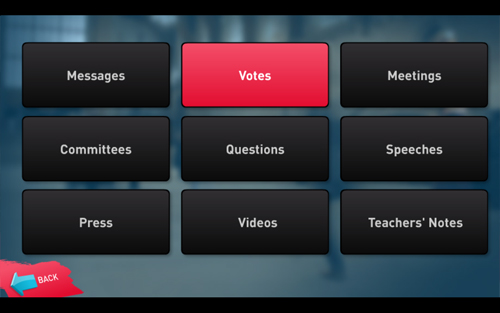 Fig 10: MP For A Week teachers’ controls
The support material accompanying MP For A Week contains detailed teachers’ notes, including clear links to the citizenship and citizenship-related learning outcomes in the English, Welsh, Scottish and Northern Irish curricula. The decision-making and debating aspects also link well with the English curriculum, and the wide range of topics covered by the resource (environment, finance, technology, etc.) are perfect springboards for discussion of a whole range of curriculum outcomes.
A further level of information is provided in the resource by real MPs offering guidance and tips to players. Approximately 40 short video clips are available at relevant points throughout the game via the help screen. These videos are also available separately on our website as a valuable standalone resource that explains the role of MPs.
Technology
Flash was chosen as the appropriate technology for this game, as it offers a rich-media, interactive experience via a plug-in that is widely available and used in schools. However, to ensure that the game is as maintainable as possible, all text for individual activities is stored in external XML files, making it easy for in-house editors to add, edit or remove content without needing to go back to the supplier.
7. Evaluation: usage data, user testing and acclaim
MP For A Week launched in January 2010 to much positive press and even more positive user and industry feedback, at a time when Parliament itself was under intense scrutiny in relation to MPs’ expenses.
The House of Commons Speaker, Rt Hon John Bercow MP, launched the game by saying: "It's vital that young people understand the role of Parliament and the work of MPs. Parliament has a duty, which should also be a pleasure, to connect with the public and MP For A Week is an innovative way for students to explore our democracy."
The resource has received 126,757 visits in the year since its launch, with an average play time of five minutes. The number of users continues to grow as we further publicise the game.
It is still early days for the project, and further evaluation is planned to ascertain the full impact of the game. However, we have summarised below the results of four initial user testing sessions. Two approaches were observed: whole class sessions led by the teacher at the front of the classroom, and paired game play by students on individual laptops. A combination of observation and formal questionnaires was used to assess the impact of the game on students.
Engagement
Students in all user testing sessions engaged with the game and found it fun and realistic. When playing individually or in pairs they remained engaged with the game for a whole lesson. Progression through the game was significantly slower in the whole-class sessions. Comments from students included:
"It was fun and enjoyable and I got to find out things I didn’t know.”
“It was like being a real MP for a week.”
Students were more engaged and demonstrated a higher level of understanding when playing individually or in pairs rather than as a whole class. Teachers in both schools had not been fully aware of the teachers’ controls and the potential for their use in isolating sections of the game.
This suggests that the teachers’ notes should more clearly recommend the most effective ways for the resource to be used.
Learning
Students’ knowledge of an MP’s role and Parliament was increased through playing the game. In some cases their awareness of their own learning increased too, such as in making decisions and critical thinking. Students’ comments included:
“It’s a hard job.”
“Members of Parliament work for everybody, and attend meetings and debates. MPs have a busy life.”
“They make new laws.”
Teachers thought the game was an excellent resource particularly for support teaching, such as homework or follow-up lessons.
Game features and usability
Students felt that the addition of more mini-games similar to ‘catching the Speaker’s eye’ and more audio, especially within the items with lots of text to read, would be beneficial.
Some of the text was too small for comfortable reading on a whiteboard from the back of the class.
8. Awards for MP For A Week
We are delighted that the successes of MP For A Week have been recognised through four awards that the resource has won in its first year. The judges have acknowledged that the game meets its objectives of engaging young people in politics and delivering quality, curriculum-focused education. They cited the combination of a difficult subject area, high-quality production values, and best-practice in online learning.
- Big Chip Awards 2010: Best public sector project
- Big Chip Awards 2010: Grand Prix winner
- E-learning Awards 2010: Best learning game, simulation or virtual environment. Judges comments: “MP For A Week is a seamless blend of photography, video, illustration and 3D design that brings the political process to life in an engaging and entertaining way to achieve its aim of raising political literacy among players.”
- BETT Awards 2011: Best Secondary, FE and Skills Digital Content. Judges comments: “A rich and varied resource that offers a genuine opportunity for young people to engage.”
9. Lessons learned
Have a clear, shared vision
A key learning point was that a clear, shared vision understood by all stakeholders was fundamental to the success of the project. It meant that any extra suggestions or queries that came up during development and production could be evaluated against the initial aims and objectives, and included or rejected as appropriate.
Embrace user-centred design
Our student testing sessions ensured we were on the right track from a design, editorial and usability perspective. Going a step further and paper prototyping specific activities would have allowed us to capture further usability and content-writing issues earlier on. For instance, the speech-making activity could have been tested quite easily on paper, yet took much more effort to optimise once built.
Do your research
Content writing on this scale was a huge creative challenge and a massive production task. Research was essential for generating original ideas and credible game scenarios. Applying different writing techniques throughout the game was invaluable in solving a number of game flow and content problems. Ideally we would have planned more time for this stage.
Be realistic
The game length (up to 45 minutes) is very long. We suspect that motivation and re-playability would be increased if there were less content in each week. A fail state well into this length of game is also very annoying for the user, as the only option is to start again right from the beginning. Additionally, many teachers have asked whether it is possible to save game progress. (This is a possible, but expensive option to implement, and would not be required if the game were shorter.) We are currently looking at reducing the overall time it takes to complete the game.
The game size is also very large. Many teachers have asked that the game be made available for local download. This would have increased uptake further, and allowed schools with slower Internet connections quicker access to the game. We are currently investigating the provision of an offline version of the game and integration with learning platforms.
Our guidance pages are quite bloated. In trying to produce comprehensive teachers’ notes, we have probably created much too detailed help documentation (when the game is quite self-explanatory). More useful would be information on extension activities and alternative methods of using the resource. We are currently reviewing the support information with this in mind.
Build evaluation in from the start
We have only very basic statistics available to us. Ideally the resource would have included more sophisticated tracking to see what settings players choose up-front, the popularity of each difficulty level, a breakdown of how far players get through the game, and which are the most popular activities. We are currently investigating adding extra analytics features.
10. Next steps
We’re very excited by the successes of MP For A Week over the past year – from launch to user feedback and critical acclaim. We aim to build on this by carrying out further evaluation and embarking on a second phase of the project.
In this second stage, we aim to address the usability issues outlined above, increase the reach of the resource, and increase play time. We are investigating ways to maximise reach by implementing sharing options such as an embed code for teachers and the ability for players to share their progress and achievements with friends. To increase game play time, we’re considering adding a new mini-game and an extra reward layer consisting of badges for completing activities.
We have learned much during this project about how to engage young audiences in politics and the work of Parliament. Our aspirations are to build on this knowledge and develop deeper online learning and engagement experiences that help equip young people with the tools, knowledge and skills to become active citizens in their democracy.
