You are hereBlogs
Blogs
Barry Wellman on the "Internet and Everyday Life": people who talk, talk!
Barry Wellman spoke last night at the University of Toronto about his ongoing research into the 'Internet in Everyday Life'. It was an interesting, but somehow dissatisfying presentation of some significant research into the role of communications technologies in maintaining social ties. If that doesn't sound like the 'Internet' to you, it's because it isn't.
Though Wellman casts his net widely, and talks about researching the Internet as a whole, his work focuses on e-mail (which when the first of these studies was conducted was the major source of traffic on the net). The most interesting set of statistics presented last night were about the inter-relationships between the use of fixed phones, mobile phones, email and SMS and how their use breaks down across type of social ties, and the distance between communicants. He found a group of people who are very heavy communicators, high users of all types of media. Communications technologies enable communication. Wow.
more steve ... tagger prototype preliminary analysis
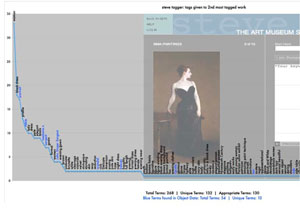 I've begun working with the data from the steve.museum prototype tagger, in preparation for a presentation at the ASIST SIG/CR workshop in Austin TX on November 4, 2006.The preliminary results, discussed in my paper [PDF preprint on-line] confirm the gap between terms provided by social tagging and those provided in professional museum documentation. We're seeing about 90% new terms in the top four, most-tagged works -- a number that really surprised me. (The blue terms in the charts are the ones that match museum documentation.)
steve presentation to the Dublin Core Accessibility Working Group
I gave a presentation today, remotely, to the Accessibility Working Group of the Dublin Core Annual Meeting about the work that the steve.museum consortium is doing exploring social tagging and folksonomy in art museums. The podcast is online, here.
The presentations reinforced for me the developing understanding of the nature of public and professional vocabularies, or wild and domesticated metadata and the dangers of presenting these as either/or options. Rather, we should be observing the development of these distinctions, the "lects" that Marc Davis talked about at the WWW2006 tagging workshop in Edinburgh, to see what we can learn about the characteristics of these different groups.
If inclusion, and diversity, are things that we value, then the rationale for such an exercise should be self-evident.
/jt
steve.museum gets imls funding
The IMLS announced today that the steve.museum application to the National Leadership Grants was successful. We'll be exploring whether social tagging and folksonomy can improve access to art museum collections on-line.
We're excited!
jt
Researching Social Tagging and Folksonomy in Art Museums
Abstract
Can social tagging and folksonomy improve access to art museum collections on-line? Our two-year research project (October 2006–September 2008) is designed to answer this question.
There are now millions of works of art from museums on the Web.
your gallery @ the guardian in association with The Saatchi Gallery

Saatchi's Your Gallery is worth a bit of time; it's a fun example of community-creation –– all artist-contributed content.
Now in association with The Guardian, the virtual gallery moves into a "real" space -- albeit the Guardian Newsroom. it's an intriguing development. Press release below.
@ UKMW2006 in Leicester: 7. Summing up
Mike Lowndes synthesizes... museums still don't know users, who they are and what they want.... and just when we think we've got them pinned down, they change, and the way that we reach them changes. Now, users themselves will be generating content in their own sites, and own spaces. "Our users are going to be in our face." -- we won't be able to hide from the re-use of museum content.
When people are empowered they are surprisingly creative and can invent new ways of looking at things. Users, like good teachers, need to be able to take the parts of the content that they need to illustrate the point that they need to make. We need to put bits of our content in their context.
@ UKMW2006 in Leicester: 6. How is museum learning provision adapting to the new web environment?
Anra Kennedy (24hr museum) chairs Marshall Mateer, Bruce Phillips and Helen Wright.
What schools need.
Marshall Mateer http://shapesoftime.net
case study: children mapping docks where Titanic was built (entering content with geopositioning).
challenge= orientation. where am i in relation to the information that i am taking in? how does it relate to me, and how do i evaluate its dimension/scale?
case study: Journey in Stone: Caedmon School Project from the Cleveland Iron Mines.
industrial heritage of area no longer in the community; mines are gone as is their central presence in the community. children are creating content, comfortable with technology.
@ UKMW2006 in Leicester: 5. what are the effects of the new online technologies -- the new social software?
jt chairs John Pratty, Mike Ellis, and Lena Maculan
Jon Pratty: clusters of ideas... thoughts and ideas that are reactions to what we've seen today in the context of the re-design of the 24-hour museum.
- rss / xml = neural network that supports new activities and opportunities: simplicity, ubiquity, connectiveness.
- search engine environment has changed sense of audience (70% of activity starts with search); mass audience of a large scale. "every page is a home page"
- nov 2005 report from international telecommunications union: on the threshold of unanimous objects, bots and data transactions dominating the web. "the internet of things" how do they communicate? how do we interact with them? rfid?
- 'curators of meaning' that operate in a space independent of specific objects and collections: is interaction a poetic intervention?
- interactions that are surprising and engaging; that use our content in new ways in new places.
@ UKMW2006 in Leicester: 4. How is this audience changing?
Ross Parry chairs Gail Durbin and Dan Phillips.
Gail talks about user contributions at the V&A site. There's a good model in their work for the transformational power of openness and simple interaction, and the additive nature of many small experiements: the chair, knitting, tatoos. Some things she notes:
- Users can fill gaps: "offer emotion, enthusiasm, and experience".
- Encouraging interaction requires a clear invitation; make it clear what people can do and the role that they can play.
- Good content encourages good content (now adding ranking to user contributed sites)
- Understanding where museums have expertise and where users have expertise, and how they are complementary is critical.
- Sue Lawtey artists in residence blog exposes creative process and inspires reaction in unanticipated places (NZ)
- Tiles as an example as a great sandbox where users perturb tool to communicate with each other
@ UKMW2006 in Leicester: 3. How do audiences discover museums online?
John Pratty chairs Mukti Bawa (PhD student at the University of Central England) and Mike Greenwood/Kati Streten
Mukti worked with the Birmingham Art Gallery to explore how users find museum web sites: directly, through a search engine, by a reference, through an academic site... two groups of users were compared, museum professionals and the general public. Preliminary results show personal interests are less specific, more likely to be satisfied by events listings, exhibitions, than by details about a specific object. 4 test sites: Birmingham, CMC, British Library online, User observation of different tasks:
1. personal interests / explore
2. unidentified image / find out about it
3. information card / find this work [how characteristics are extracted from print]
--> browse, search and find
@ UKMW2006 in Leicester: 2. Who is out there?
Mike Lowndes chairs Brian Kelley and Caroline John.
What tools are there beyond web log analysis, and what kind of intelligent analysis methods can we use to build our understanding of what people do on museum web sites.
Brian#039s talk looked at impact analysis: interesting that web 2.0 applications, like technorati and flickr can point out where people cared enough about an event to make a note of it.
Caroline John reviewed the evaluation stages that her project in Birmingham reviewed; they#039ve used learning styles and learning outcomes as a way to define and articulate the nature of their audiences.
@ UKMW2006 in Leicester: 1. opening plenary
i am at the annual UK museums and the web conference http://www.museumscomputergroup.org.uk/meetings/2-2006.shtml (no affiliation with our MW conferences), where i have just given the keynote presentation, following Simon Waldman of the Guardian Unlimited. Simon -- who has been with the on-line edition of the paper since 1999, wandered through The New Content Landscape, drawing some useful parallels between publishing a newspaper on-line and making cultural content accessible in the networked space. I was intrigued to hear him struggling with the realization that they had accumulated a significant legacy of on-line content, and that a full 1/3 of their traffic was to stories more than 3 months old. A big challenge for an organization attuned to recreating the view of the wold every day.
consolidating postings
i'm slowly moving all my various blog postings here; it's time to develop a center of gravity... /jt
Goshen live at the post conference party.
A great band for those of us steeped in rawk n roll, Goshen played a blinder.
They played original music, a kind of mutant punk blues-rockabilly - the driving rhythyms of Bo Diddley rocked up by George Thorogood gone hillbilly. A heck of racket for just two guys - for three numbers I was convinced a bass player was hidden away somewhere, but no - just a seriously heavy bottom E string drove the sound. Even people who wern't too keen on rock'n'roll appreciated the energy and belief they put in - its not common to see someone so 'in the zone' as Grant Hayunga.
If they did one thing not so well, it was in marketing themselves - it was only by chance as, the coach waited, that I found out a CD was available and only learned their name from the cover. Go find and buy from http://www.goshen-music.com/.