You are hereresearch
research
Break-down of topics for Research Forum discussion and review of research generally
New York Times on Social Tagging and Art
there was an article in the New York Times this week about social tagging and art that focuses on tagging as a way to bridge the gap between museums as institutions as museum-goers as individuals. when museum professionals talk about introducing people to the collections, their thoughts turn to tours, or slide-shows, or other packaged information products that force visitors' self-identification as a 'beginner". And who wants define themselves as a newbie?
ICHIM07: Call for Papers
International Cultural Heritage Informatics Meetings
October 24-26, 2007
Toronto, Ontario, Canada
http://www.archimuse.com/ichim07/
Curating Ambiguity
In autumn 2006 the Electronic Literature Organization (ELO) released the Electronic Literature Collection Volume One, including selected works in New Media forms such as Hypertext Fiction, Kinetic Poetry, generative and combinatory forms, Network Writing, Codework, 3D, and Narrative Animations.
Call for Papers: WWW2007 Tagging Workshop
WWW2007 Workshop:
Tagging and Metadata for Social Information Organization
Tuesday May 8, 2007, Banff, Alberta, Canada
Call For Papers and Participation
automatic linguistic indexing of images, compared to user tagging / folksonomy
 I've just been playing with another experimental image indexing tool, that's using image analysis to suggest keywords for images, called ALIPR: Automatic Linguistic Indexing of Pictures. You feed it an image file, or a URL to a web accessible image, and it suggests keywords that might apply to that image. You're then prompted to correct the suggestions, and add alteratives, so the program "learns" through user feedback and prompting.
@ ASIST SIG-CR - final session
Panel 4: Conceptual Frameworks for Social Classification
An examination of authority in social classification systems [PDF]
Melanie Feinberg (University of Washington, USA)
http://www.slais.ubc.ca/users/sigcr/sigcr-06feinberg.pdf
@ ASIST SIG-CR afternoon session on visual resources
My paper led this session
Social Classification and Folksonomy in Art Museums: early data from the steve.museum tagger prototype.
J. Trant (Archives & Museum informatics / University of Toronto)
see http://www.archimuse.com/papers/asist-CR-steve-0611.pdf
@ ASIST SIG-CR: second session
Exploring characteristics of social classification
Xia Lin, Joan E. Beaudoin, Yen Bui, and Kaushal Desai (Drexel University, USA)
http://www.slais.ubc.ca/users/sigcr/sigcr-06lin.pdf
- reference to his sig-cr paper in 1997 that talked about distributed indexing
- paper reports on work in doctoral seminar @ Drexel
- IMLS-funded project: interdisciplinary perspectives on information organization in the digital environment
- Is there a paradigm shift from traditional information organization to digital information organization?
- contrasts traditional/thesaurus (concept-based, static, domain-specific, constructed, independent of documents) with digital/dynamic (connection-based, dynamic, social-network based [ jt-same words ≠ social network] , large-scale, integrated document and concept space)
Experiments done in class
1. compare terms w controlled vocabulary
asking nownow.com : Is faceted indexing the future of social tagging?
Three answers from ask@nownow.com to Joseph's question....
@ ASIST SIG-CR workshop on social cassification in Austin - opening
I'm at the SIG-CR workshop on before the ASIS&T Annual Meeting in Austin TX, listening to information scientists discuss Social Classification. Papers on-line at http://www.slais.ubc.ca/users/sigcr/events.html
Barry Wellman on the "Internet and Everyday Life": people who talk, talk!
Barry Wellman spoke last night at the University of Toronto about his ongoing research into the 'Internet in Everyday Life'. It was an interesting, but somehow dissatisfying presentation of some significant research into the role of communications technologies in maintaining social ties. If that doesn't sound like the 'Internet' to you, it's because it isn't.
Though Wellman casts his net widely, and talks about researching the Internet as a whole, his work focuses on e-mail (which when the first of these studies was conducted was the major source of traffic on the net). The most interesting set of statistics presented last night were about the inter-relationships between the use of fixed phones, mobile phones, email and SMS and how their use breaks down across type of social ties, and the distance between communicants. He found a group of people who are very heavy communicators, high users of all types of media. Communications technologies enable communication. Wow.
more steve ... tagger prototype preliminary analysis
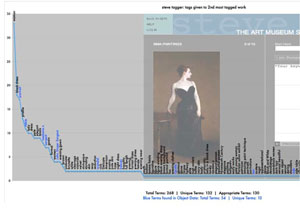 I've begun working with the data from the steve.museum prototype tagger, in preparation for a presentation at the ASIST SIG/CR workshop in Austin TX on November 4, 2006.The preliminary results, discussed in my paper [PDF preprint on-line] confirm the gap between terms provided by social tagging and those provided in professional museum documentation. We're seeing about 90% new terms in the top four, most-tagged works -- a number that really surprised me. (The blue terms in the charts are the ones that match museum documentation.)
steve.museum gets imls funding
The IMLS announced today that the steve.museum application to the National Leadership Grants was successful. We'll be exploring whether social tagging and folksonomy can improve access to art museum collections on-line.
We're excited!
jt
Researching Social Tagging and Folksonomy in Art Museums
Abstract
Can social tagging and folksonomy improve access to art museum collections on-line? Our two-year research project (October 2006–September 2008) is designed to answer this question.
There are now millions of works of art from museums on the Web.
Research work in progress/ welcome opinions/ discussion
Our research work in progress deals with augmented reality in museum collections. The example of the decorative arts collection of the Museo nacional de Colombia. Would like feedback opinions and coments. (attached we include a recently edited article on our works progress)