You are hereresearch / folksonomy
folksonomy
automatic linguistic indexing of images, compared to user tagging / folksonomy
 I've just been playing with another experimental image indexing tool, that's using image analysis to suggest keywords for images, called ALIPR: Automatic Linguistic Indexing of Pictures. You feed it an image file, or a URL to a web accessible image, and it suggests keywords that might apply to that image. You're then prompted to correct the suggestions, and add alteratives, so the program "learns" through user feedback and prompting.
@ ASIST SIG-CR - final session
Panel 4: Conceptual Frameworks for Social Classification
An examination of authority in social classification systems [PDF]
Melanie Feinberg (University of Washington, USA)
http://www.slais.ubc.ca/users/sigcr/sigcr-06feinberg.pdf
@ ASIST SIG-CR afternoon session on visual resources
My paper led this session
Social Classification and Folksonomy in Art Museums: early data from the steve.museum tagger prototype.
J. Trant (Archives & Museum informatics / University of Toronto)
see http://www.archimuse.com/papers/asist-CR-steve-0611.pdf
@ ASIST SIG-CR: second session
Exploring characteristics of social classification
Xia Lin, Joan E. Beaudoin, Yen Bui, and Kaushal Desai (Drexel University, USA)
http://www.slais.ubc.ca/users/sigcr/sigcr-06lin.pdf
- reference to his sig-cr paper in 1997 that talked about distributed indexing
- paper reports on work in doctoral seminar @ Drexel
- IMLS-funded project: interdisciplinary perspectives on information organization in the digital environment
- Is there a paradigm shift from traditional information organization to digital information organization?
- contrasts traditional/thesaurus (concept-based, static, domain-specific, constructed, independent of documents) with digital/dynamic (connection-based, dynamic, social-network based [ jt-same words ≠ social network] , large-scale, integrated document and concept space)
Experiments done in class
1. compare terms w controlled vocabulary
asking nownow.com : Is faceted indexing the future of social tagging?
Three answers from ask@nownow.com to Joseph's question....
@ ASIST SIG-CR workshop on social cassification in Austin - opening
I'm at the SIG-CR workshop on before the ASIS&T Annual Meeting in Austin TX, listening to information scientists discuss Social Classification. Papers on-line at http://www.slais.ubc.ca/users/sigcr/events.html
more steve ... tagger prototype preliminary analysis
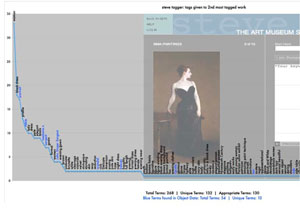 I've begun working with the data from the steve.museum prototype tagger, in preparation for a presentation at the ASIST SIG/CR workshop in Austin TX on November 4, 2006.The preliminary results, discussed in my paper [PDF preprint on-line] confirm the gap between terms provided by social tagging and those provided in professional museum documentation. We're seeing about 90% new terms in the top four, most-tagged works -- a number that really surprised me. (The blue terms in the charts are the ones that match museum documentation.)
steve presentation to the Dublin Core Accessibility Working Group
I gave a presentation today, remotely, to the Accessibility Working Group of the Dublin Core Annual Meeting about the work that the steve.museum consortium is doing exploring social tagging and folksonomy in art museums. The podcast is online, here.
The presentations reinforced for me the developing understanding of the nature of public and professional vocabularies, or wild and domesticated metadata and the dangers of presenting these as either/or options. Rather, we should be observing the development of these distinctions, the "lects" that Marc Davis talked about at the WWW2006 tagging workshop in Edinburgh, to see what we can learn about the characteristics of these different groups.
If inclusion, and diversity, are things that we value, then the rationale for such an exercise should be self-evident.
/jt
steve.museum gets imls funding
The IMLS announced today that the steve.museum application to the National Leadership Grants was successful. We'll be exploring whether social tagging and folksonomy can improve access to art museum collections on-line.
We're excited!
jt
Researching Social Tagging and Folksonomy in Art Museums
Abstract
Can social tagging and folksonomy improve access to art museum collections on-line? Our two-year research project (October 2006–September 2008) is designed to answer this question.
There are now millions of works of art from museums on the Web.
your gallery @ the guardian in association with The Saatchi Gallery

Saatchi's Your Gallery is worth a bit of time; it's a fun example of community-creation –– all artist-contributed content.
Now in association with The Guardian, the virtual gallery moves into a "real" space -- albeit the Guardian Newsroom. it's an intriguing development. Press release below.
steve gets a mention in cnet.
'Tagging' gives Web a human meaning | CNET News.com
You have to keep going until the last page... but if you plow through the discussion of the basics of tagging, you'll find that steve has intrigued Thomas Vander Wal enough for him to mention us (though not specifically).
I talked with him yesterday about steve when we were both at a Symposium on Social Architecture ... and it looks like there's some follow-up in the cards.
tags are personal
the fundamental value of tagging came home to me in the midst of an argument with Salim Ismail at lunch during the Corante Symposium on Social Architecture. We were debating the long term utility of tags. Tags would soon become obsolete he maintained: tags as ways to describe content would be superceeded by better ways to index information resources.
If a tag was just about a resource, if it functioned purely as a neutral descriptor, then yes, self-describing content would make tags obsolete. But is that what tags are?
- « first
- ‹ previous
- 1
- 2
- 3