You are hereBlogs
Blogs
RFP: AAM + ACM session (Five-Minute Media Matinee and Big Impact/Low Budget)
AAM + ACM session (Five-Minute Media Matinee and Big Impact/Low Budget)
Has your museum been experimenting with different types of media outlets and devices to advance your promotional or educational goals? Do you know of someone who has? We'd like to know about it!

hosting/collaborative infrastructure
Hello, all:
Sorry for any cross posting...
=================================
The NY Hall of Science has gone through several iterations of email hosting solutions from large plain IMAP/POP hosts like Verizon to smaller Lotus Notes hosting services. When Google premiered their Google Apps enterprise service last year, we gave it a good long look and decided to take the plunge.
LC Flickr Commons Report Available
the Library of Congress has made a detailed report of their experiments with the Flickr Commons available on their web site at http://www.loc.gov/rr/print/flickr_pilot.html
They note the following in their summary:
Culture Geeks - December's talk: multilingual subject access to collections
 The next Culture Geeks’ talk is a special Christmas edition, with
speaker Etienne Posthomus, who will be joining us from Amsterdam to talk
about:
" The polyglot collection – making multilingual subject access to collections possible using ICONCLASS and Arkyves "
At http://www.arkyves.org/
Arkyves you will find a collection of images and descriptive metadata
how not to encourage web participation at a conference
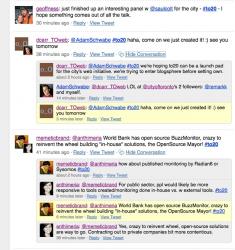 i spent a chunk of today "participating online" in the 'web 2.0 summit' hosted by the City of Toronto, subtitled "Moving towards Government 2.0" [see the Agenda]. i hadn't heard anything about it until a tweet from Kevin Von Appen of the Ontario Science Centre mentioned he was speaking. the event offered 'on-line participation' and since i didn't have a time to head downtown i figured i'd check it out.
what i got was a lesson in how not to run an on-line event. rather than use the opportunity to model the kinds of changes in communications patterns that 'web 2.0' tech enables, the event was a one-way, an opportunity to watch 'guys in the know' talk to each other. video went out from the meeting, complete with horrible music when there was a break in the audio feed. "questions" could be submitted through an 'ask a question' form, but they turned out to be highly moderated. [there was no mention of moderation anywhere in the prep materials.] there was a link to 'view the moderators board', but from my experience a lot of what was asked never made it there. at one point it disappeared completely for me. there was also a form to enter 'comments'. where they went was anyone's guess. i couldn't find any trace of what i submitted, anywhere [though tech support did tell me the went 'into the same database as everything else'. how reassuring.]
there's no such thing as 'museum content'
There's a sentence from the Museums and the Web 2008 Proceedings that keeps coming back to me, as i think about things as wide-ranging as tag analysis for steve.museum, and the nature of professional training in museums, archives and libraries.
When discussing the use of museum-materials posted on YouTube a group of museum professionals noted that “the people watching this were not searching for ‘museum’ content; they were searching for "calligraphy" content” (Alexander et al., 2008).
upcoming presentation: steve.museum research results @ mcn
 as principal investigator of the steve.museum IMLS research grant, wrapping up this december, i'll be presenting further results from our tagging study at the upcoming museum computer network conference:
Friday November 14, 2008
Grand Hyatt, Washington, DC
Should You Care about Social Tagging? – Findings and Recommendations from steve.museum
tagging and folksonomy keynote @ DC2008
 i gave a keynote this morning at the Dublin Core Metadata Meeting - DC2008 on access to art museums on-line: a role for social tagging and folksonomy? that reports on more of the steve.museum tagging data analysis. this talk built on what i reported at NKOS last week [steve.museum: public and professional vocabularies. presentation @ NKOS 2008] and extended it to include some thoughts on user-generated metadata – useful in the context of DC, which began its life as a format for encoding user-created metadata – and a bit of work about the relationships between tags and search logs.
my slides are here (without some of the funky builds).
while we'd hypothesized that there might be a tight relationship between tags and search terms, what we found was a much looser coupling. whether this is a self-fulilling prophesy – because searches on the kinds of subject and genre terms that they use to tag fail, people don't use them – or because description and retrieval vocabularies vary at some other level still needs some thought. that's what the examples we looked at seemed to indicate, and a place i'll be looking further.
steve.museum: public and professional vocabularies. presentation @ NKOS 2008
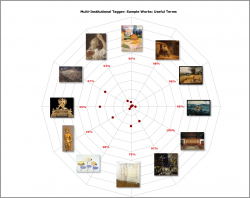 David and i presented the first of the steve.museum research results at the NKOS workshop today. the [many] slides are attached to this post. the take aways, though, can be easily summarized:
85%+ of tags are not found in museum documentation
60%+ tags don't match vocabularies [and those that do match ambiguously]
most tags can't be mined from other sources [like published catalogues or other scholarly works]
Public tagging vocabulary is different from the vocabulary in museum professional documentation. So tagging does contribute.
Contribute to what? well, we still need to look further into the details, particularly the relationships between tags and search terms to talk about that with more confidence. Watch for that from the Dublin Core (DC2008) meeting next week.
upcoming presentations on tagging and art museums
the fall travel season is starting up again, and we're in Europe this week and next presenting research results from the steve.museum project. watch for the following:
Public and professional vocabularies: comparing user tagging with museum documents and documentation
The 7th European Networked Knowledge Organization Systems (NKOS) Workshop at the 12th ECDL Conference, Aarhus, Denmark
Friday September 19th 2008 [see the program on-line]David and i will be talking about the differences between public tagging vocabularies and the language of art cataloguing and curators.
and
steve.museum: tagging art. research and results
International Conference on Dublin Core and Metadata Applications, Berlin, Germany
Tuesday 23 September 2008 [see the program on-line]i'm keynoting DC2008 – talking about the role of tagging in retrieval-focused museum metadata.
We're are looking forward to catching up with old friends, and – of course – i'll be posting notes and thoughts as we go.
IMA blogs in-gallery interactive

The Indianapolis Museum of Art software development team has blogged some stats about an interactive installed in their Asian galleries, including some details about how and where it's touched. intriguing how, as Charlie Moad says, the heat map shows that people wanted to use the interface in the inverse way from how it was designed: they wanted to use the geographical map to find the work, not plot the work on the map.
our paradigms are shifting: "it’s google maps fault"
Special Issue of Museum Management and Curatorship of ICHIM07 papers
Recently we've been helping editors Ross Parry and Paul Marty put together a special issue of Museum Management and Curatorship containing articles from ICHIM07. Our introduction (http://www.archimuse.com/publishing/MMC-ichim07-intro.html) to the issue, which will contain five articles focused on organizations and changes created by multimedia online, looks back at 16 years of ICHIM history, locating today's discussions in some of the earliest themes from the past.
Job: Program Manager, Interactive Educational Technologies at SFMOMA
One of the key positions in the SFMOMA IET team has just opened up: the Program Manager, IET. Read on for details.
Best,
Peter Samis - Associate Curator, Interpretation
New study on factors that improve online experiences
IDEA, the Institute for Dynamic Educational Advancement, just released “Finding Information: Factors that improve online experiences,” which reports the findings of a study that the California-based nonprofit organization conducted recently.