You are hereBlogs
Blogs
at MCN 2007 in Chicago: access, engagement and community, what web 2.0 has to offer
Clive Izard and Michael Stocking present interactive activities at the British Library. it's not like this:
they built on the success of their Turning the Pages applications, that let you page through treasures from the BL (presented in Shockwave) each of which was is separately created and individually animated. they partnered with microsoft to demonstrate vista, and created Turning the Pages 2.0 that takes advantage of its 3D capabilities. it includes animations of 'book dynamics' [turning pages] based on curators actually turning the pages, so the pages wrinkle and curl. a light source reflects off the gold leaf. browsing is enhanced by navigation, englargement, transcription, and comparison of multiple volumes in the same workspace (with relative size). functionality was defined in conjunction with curators (based on tasks like comparing multiple editions, sketches and published works...)
at mcn in chicago: informal learning spaces
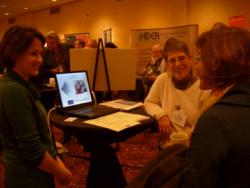
The MCN program this year includes a number of opportunities for less structured learning, and conversation.
IMLS Project Demonstrations on Wednesday introduced projects funded by US Institute of Museum and Library Services (IMLS) National Leadership Grants. during a coffee break, delegates could wander through the demonstrations, see the projects that were funded, and identify people to talk to later about how to make their next grant application work.
This morning, a new format of "Case Studies" introduced a series of projects in brief (5 minute) introductions that were followed by break-out discussions. it looks like this format might work, but the spaces provided for the breakouts [single tables per topic at the back of the room], and the lack of coffee [at least for me], might have limited the discussions.
However, they were good conversations, and this is a format that should be pursued.
at mcn in chicago: new spaces, new measures. measuring success
Sheila Carey chairs a session on evauation in web spaces.
Beth Kanter {see http://beth.typepad.com/beths_blog/] on evaluating social media talks about moving beyond measuring static use of web sites to get at ways of appreciating the impact of social media.She cites Scoble: audience, engagement, loyalty, influence, and action for some principles that help understand the impact of a site in a social media context. Overally, she notes that trends are more important than actual numbers, as many of these measures (such as ) are hard to quantify. See socialmediametrics.wikispaces.com for a link to her slides.
Tim Hart introduces analytics as used at the Getty Trust, and the challenges of adapting measures that are e-commerce focused to mission-driven organizations. As an example, he looks at a page from the Getty Museum Site. The click map shows that people are going to the things that the page highlight; netgenesis stats show more detail, that lets you compare clicks to actual usage?. it makes it clear that many people link deep into the site, and that section pages aren't necessarily seen. but bot and spider traffic are a significant number of page views and need to be removed (javascript based tools can help filter those out). trends are more important than actual numbers. Metrics need to be compared to other measures, including interviews, visits ...
at MCN in Chicago: CDWA lite
Gunter Waibel chairs a session with Alan Seal (Victoria & Albert Museum) and Michael Jenkins (The Metropolitan Museum of Art) are updating us on the activities at their institutions using CDWA-lite and OAI as mechanisms for exchanging information. Jean Goodby will then talk about the role of these protocols in the broader information discovery environment.
Alan Seal: at the V&A the data format and the protocol were part of an overall strategy to surface data and images from the entire collection on the web, to meet their director's desire to see their work s show up in a google search. They are creating URIs for all of their catalogue records to support web searching. CDWA-lite is a useful integration tool.
Michael Jenkins: scholars licence as a real test of the use of the protocol, to make images from the MMA available to scholars for academic use, using ArtStor as a means of delivery. ArtStor developed the tech tools. At the MMA, CDWA-lite data structure was used as the mechanism to move data from the many collections management databases (one system, departmental implementations) to metmuseum.org
MCN in chicago: directors and it professionals
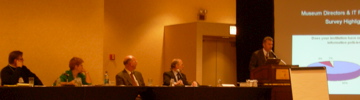
Nik Honeysett moderates a panel of two directors who share the podium with their heads of IT staff.
James Cuno, Director of the Art Institute of Chicago, is a techno-convert, realising that his daughters live in a world where information is on-line, people have ipods and the museum is featured on YouTube in visitor-created videos. Committed resources, time and staff, to make this happen.
Janice Klein, Director of the Mitchell Museum of the American Museum, is in a small museum, without IT staff, struggling to manage technology with volunteers and limited expertise. Challenge of maintaining infrastructure is significant; her colleagues are focused on outcomes and technology is a tool. Drivers are often the members of the Board.
Sam Quigley has a privledged position as an IT person at the table with museum senior management (thought his isn't as rare as it once was).
John Dodge works on 'soft money', responding to immediate needs.
Nik: how do we develop the understanding of technology at a strategic level?
at MCN in Chicago: past presidents' panel

Jim Michalko introduced a panel of MCN's Past Presidents: Diane Zorich, Susan Patterson, Chuck Patch, Sam Quigley, Marla Misunas
The panel reflected on the history of MCN, and the challenges that they faced during their tenure, adminstrative, or mission-based. They reflected on challenges such as internationalization, collaboration across the discipline and beyond it, standards deveopment (particularly with CIMI), communications (spectra, web site development, board and governance).
Jim asked the panel to reflect on the issues that the profession has faced, and our achievements in past few years.
Quigley: professional development is a critical issue for us all. we need to find a way to go for it, and define the question of competencies, to help people with training.
Zorich: AAM and MCN need to refine their relationship, to raise the voice for technology at the leadership level.
Misunas: noted that Holley Witchey has helped play this role, particularly when MCN has exhibited at AAM. [Holly mentioned a Musematic post -- but a quick google doesn't find it, help? Thanks to Richard, see below, here's the link: http://musematic.net/?p=46))
at MCN in Chicago: Town Hall Conversation on Professionalism and Leadership
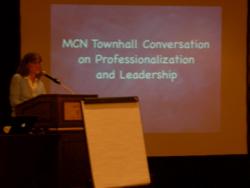 the second plenary session is focused on the role MCN might play in the development of information professionals in the museum field. building on issues from last year -- feedback on challenges and impediments in own job and role of mcn -- the floor was opened for discussion around these topics:
- communication with administration: helping management understand the issues and value in museum tech
- professionalization of the field (including core competencies?)
- resources and role of mcn [facilitating doing own jobs and enabling collaboration; e.g. job descriptions, project registry]
suggestions on resources MCN could develop from Paul Marty:
- job descriptions
- project registry
- shared bibliography/reading list
- instituitonal repository
- open source software/tools
Holly Witchey: why doesnt this field publish? Practicioners don't write... should we be expecting them to?
at MCN in Chicago: museum studies then and now
 mcn in chicago: opening plenaryi'm at MCN in Chicago for the next few days, and i'll be blogging my notes. first up, a day on professionalization and changes in the field, as th is is MCN's 40th anniversary.
Museum Studies Programs: That Was Then, This Is Now
Marla Misunas began this session by surveying the emergence of 'computer skills' as a requirement in collections management jobs advertised in Aviso. Amusingly, she notes, these were required first in assistant registrars, before registrars had to be computer literate. Marla suggests that the following skills are required for collections managers:
Social Tagging and Access to Collections: podcast + some followup thoughts
 i was supposed to be in Brazil this morning, talking about "Social Tagging and Access to Collections". unfortunately, visa problems made that trip impossible. the presentation was made via podcast; i've put the files on-line.
it's an introduction to the issues that we're exploring in the steve.museum project – how social tagging might enable access to art collections – focusing on the gap between user interests (as we know them from queries and reference questions) and museum documentation as created by and for professionals. This work is more formally presented in other steve papers (see below).
that gap exists partially because our documentation standards are theoretical; designed by and for professionals to serve museum functions. i've participated in many initiatives that explored aspects of access to collections – CHIN, FDA, AITF/CDWA, CIDOC, MESL, AMICO – winner take all in the aconymble contest – and don't dispute this as a valid first premise. it's a place we had to start from, but it may not put us in a good position to support public access.
museum data is still seldom shared beyond the bounds of local systems; and when it is, in early cases like MESL or building The AMICO Library, we discover that institutions adapt standards, rather than adopting them. merging data from disparate sources is hard. we compromise on what has to be merged and end up with thin (lowest common denominator) descriptions that may not be adequate for differentiation between similar objects, and may not support user needs.
i'm more convinced, since the discussion with seb and mike about the contribution of tags, that we need to look at the types of terms we're getting as tags and the types of terms searched, when we build on my preliminary analysis of Guggenheim search logs as part of the steve.museum term analysis.
that way, we'll be able to learn a bit more about the relationship between tag, searches, and documentation structures, and do it within the context of searchers' needs.
Amsterdam Museums go Mobile
From museumlab.org:
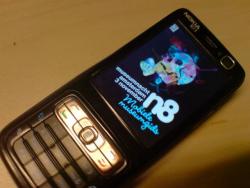
KPN Mobile Museum Guide
Readers of this blog have seen a recent surge in news on the Amsterdam Museum Night. The latest instalment in this series is the KPN Mobile Museum Guide. Visitors of the Museum Night can text 'n8' to 4628 to receive the complete program on their mobile phone. The Mobile Museum Guide includes an interactive map of Amsterdam with all the museums, the n8 blog, nachtgeluiden, a quiz and an interactive tour with Blue Tooth, designed for the Amsterdam City Archives.
In the future, the n8 intends to build upon the current infrastructure to launch more services, such as streaming audio and video, mapping and tagging. The Mobile Museum Guide was launched on 24 October. The Amsterdam Museum Night will take place on Saturday 3 November.
user contributed content @ the Whitney
 The New York Times has published some great photographs of artist Rudolf Stingel's installation at the Whitney Museum of American Art. to accompany a brief piece by Roberta Smith.
With the gallery walls themselves as canvas, visitors have been asked to complete the work done at the Museum of Contemporary Art in Chicago, whose work comprises the upper level of the piece.
The result is a definite contrast to the white cube.
/jt
steve.museum paper for ichim07

we've just released the steve.museum paper that provides background to the demonstration Susan Chun will be giving at ICHIM07. it begins to present the methods for steve.museum's IMLS-funded national leadership grant (research), focussing on our data collection strategy and the steve tagger.
it also includes some preliminary results about attitudes to tagging amongst museum staff, and early analyses of tags collected. Early results in prototype tests are holding up. We're seeing a greater than 75% new tag rate:
"Of the tags assigned to all works during Term Set 1 (March 27– July 11, 2007), 76.5% (7,973 of 10,418) were not found in museum documentation." (Trant 2007)
That means that, during our first phase of data collection, more than three-quarters of the tags assigned in the steve tagger were not found in the museum's own documentation for those works.
/jt
Trant (2007). Trant, J., et al., The eye of the beholder: steve.museum and social tagging of museum collections
, in International Cultural Heritage Informatics Meeting (ICHIM07): Proceedings, J. Trant and D. Bearman (eds). Toronto: Archives & Museum Informatics. 2007. Published September 30, 2007 at http://www.archimuse.com/ichim07/papers/trant/trant.html
20 countries to be represented at ICHIM07
 To date, 20 countries will be represented at ICHIM07 in Toronto, October 24-26, 2007.
- Australia
- Austria
- Belgium
- Canada
- Denmark
- Estonia
- France
- Germany
- Greece
- India
- Ireland
- Italy
- Japan
- New Zealand
- Norway
- Scotland
- Sweden
- The Netherlands
- United Kingdom
- USA
As can be seen from the papers on-line, this ICHIM is going to be a great opportunity for interchange, and a chance to see a broad range of diverse cultural heritage informatics applications. With time still to register, i'm sure we'll add to an already impressively diverse group of delegates.
/jt
Call For Papers: art blogging == global.exhibit(local);
New Media Caucus CAA Affiliate Panel
Call for Papers:
CAA Conference: February 20-23, 2008 in Dallas
Panel Title: art blogging == global.exhibit(local);
Panel Chair: Paul Catanese
Assistant Professor of New Media
San Francisco State University
Email: paulc@sfsu.edu
Ranjit Makkuni at ICHIM

Ranjit Makkuni, President of the Sacred World Foundation, our ICHIM Closing Plenary speaker this year, has been receiving a great deal of attention lately. He:
- was featured in an extensive interview with Mark Vanderbeeken at the Torino 2008 World Design Capital site http://www.torinoworlddesigncapital.it/portale/en/content.php?sezioneID=47
- received a feature in Business week in February http://www.businessweek.com/innovate/content/feb2007/id20070226_426602.htm and
- won recognition from ID Magazine last year http://sacredworld.com/asp/Interactive%20Media%20Design%20.htm