You are hereBlogs
Blogs
Web 2.0 data for my workshop
I am developing a workshop on how we as professionals are using Web 2.0 "to expand a museum’s role by promoting new methods of collaboration within itself and with other museums and institutions" and am looking for examples that I can use in the dialogue. I created a wiki for this discussion at http://redberry.pbwiki.com/ (password is "share").
Please join the discussion!
Back to the Future: Multiple Perspectives on Historical Exhibits
It seems like the more time we spend online, the more we value real experiences. However, there are some things, like history, that can only be replicated, not experienced. Fortunately, the digital medium is ideally suited to illuminating the past.
today i tagged someone 'failure'
not "a failure", btw, but "failure" ... something that i don't think we talk about enough.
This reminded me that tags take their meaning not just from what they say, but from the position they occupy between people and their interests.
My tags are liminal objects, staking out a boundary between me and stuff out there that i care about. That boundary isn't fixed, but variable. And it's that variablility in the boundary condition that makes tag analysis as challenging as it is. Sometimes the ties are strong, sometimes they're weaker ... sometimes i invest a lot in tagging, sometimes it's quick and done...
studying tag vocabulary is a window into what people notice. it's interesting as much for the aggregate (what many people notice) as for the outlier (what's noticed only by one).
/jt
Nonprofit IT Staffing: Budgets, Salaries, Training and Planning; a new report
 The second part of the Nonprofit Technology Network (NTEN) report on information technology in Not for Profits is now available. Nonprofit IT Staffing: Budgets, Salaries, Training and Planning reports the results of a USA national survey.
Findings of the second Nonprofit IT Staffing Report include:
Digital Information Strategy
As an informal advisor to Ian Wilson, Librarian and Archivist of Canada, I was invited to comment on the Library and Archives o Canada's recent draft Canadian Digital information Strategy (see http://www.collectionscanada.gc.ca/cdis/012033-1050.51-e.html). Why is it that such documents are so sterile and predictable? Ian launched this exercise as a way to promote the digitization and online access to all of Canada's publications, which was a truly radical idea floated in his MW2005 keynote in Vancouver (http://www.archimuse.com/mw2005/papers/wilson/wilson.html). But the requirements of involving all the stakeholders, holding extensive public reviews, and turning it over to senior bureaucrats from the LAC, has given birth to an anodyne prescription for public policy where what is needed is strong action, now.
museums, social situations, control and trust
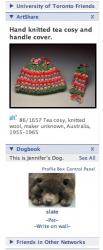 i've been thinking a bit about the relationship museums have with their collections; about the sense of responsibility to preserve and interpret that comes with custody, and about what might change in an environment where social network spaces are the norm.
in 1997 at the first Museums and the Web museums were really worried about questions of control. there were long discussions about appropriation, about commercial use, and a lot of angst about the possibilities of mugs and keychains. partly this was based on the fact that corbis (aka continuum, aka interactive home systems) had been buying rights in the area, and creating a sense that there must be a market for museum images.
New Report: Nonprofit IT Staffing: Staffing Levels, Recruiting, Retention, and Outsourcing
 There's a new report out from NTEN and the Nonprofit Times about IT staffing in Not for Profits. Download the report
Highlights from the Executive Summary:
- On average, nonprofits employ one IT staff member for every 18 employees.
- Most nonprofits continue to feel understaffed when it comes to IT. Size of organization did not seem
to impact staffing satisfaction.
- IT staff spend their time in much the same way, regardless of organization size or level of technology adoption. For the second year, the largest percentage of staff time, roughly 40%, is spent on desktop and application support.
- The average tenure for IT staff at nonprofits is 4.3 years. Tenures were longer for larger organizations and organizations that felt they had greater technology adoption.
- Almost all nonprofits outsource at least some technology tasks; more technical tasks continue to be
more commonly outsourced.
There are reports coming on Salaries & Budgets and IT Management & Planning based on the same survey
Museums and Scholarly Information - Near Neighbors Need to Understand Each Other Better
In a recently published article in the EDUCAUSE Review (http://connect.educause.edu/Library/EDUCAUSE+Review/RepatriationReconstr... ), Clifford Lynch, Executive Director of the Coalition for Networked Information, grapples with the complex issue of repatriation of cultural artifacts from museums and argues that the responsibilities of stewardship extend to capturing and distributing high quality digital surrogates that can ensure continuing scholarly access to artifacts of disputed ownership and morally ambivalent provenance.
We look forward to having Cliff at the 2008 Museums and the Web conference, where he has agreed to sum up the meeting and react to it in the closing plenary. His opinion and expertise in matters of higher education networking is internationally respected and over the years, Clifford has been an interested and sympathetic observer of the affairs of museums. Occasionally, as in the planning for the Art Museum Image Consortium, Clifford has become directly involved in museum matters. I am excited that we are going to re-engage him in thinking about strategies for museum networking at what I consider a crucial time.
From sharing cycles to sharing skills
In 1999, David Anderson launched Seti@home and with it a method of enlisting the underused cycles of PC's worldwide. While Seti still hasn't found any extra-terrestrial life, it did give birth to BOINC (Berkeley Open Infrastructure for Network Computing) which Anderson established in 2002. The Economist, December 6 edition, reports that BOINC based computing supports several hundred CPU intensive scientific investigations and has recently been augmented to use PC graphic cards and Playstations for some graphically demanding processing.
The article also identifies some social applications of BOINC of interest to museums. Galaxy Zoo has employed more than 100,000 volunteers to examine the Sloan Digital Sky Survey to classify galaxies and Stardust@home is using volunteers to spot stellar tracks. The Manchester Museum has had volunteers cataloguing 12,000 herbaria specimens from the 19th century. Africa@home from the University of Geneva is enlisting volunteers to extract cartographic data on the location of roads, villages, fields etc. from satellite images.
Projects like these have led Anderson to launch a new platform he calls BOSSA (Berkeley Open System for Skills Aggregation) which he hopes will be lower the barrier to entry for such web-based knowledge sharing and collaboration projects. Check it out at http://boinc.berkeley.edu/trac/wiki/BossaIntro
..
Open Archives Initiative - Object Reuse and Exchange (ORE) Specification
How can a web object have a defined meaning in the context of the objects discovered at the same site, a group of different objects with which it was sold at auction, and yet other objects displayed in the same museum exhibition years later, when each of the individual objects will have one or many URI’s and representations on the Web?
How, in other words, can the meanings of different aggregations of digital objects be retained over time?
Announcing the 2008 AAM MUSE Awards
Announcing the 2008 AAM MUSE Awards
Recognizing outstanding achievement in museum media, the AAM Media and Technology Committee announces the 19th annual MUSE Awards competition.
The 2007 MUSE Awards competition received nearly 200 applications from a wide variety of museums in North America, Europe, Australia, and Asia. Entries included audio, cell phone, and interactive handheld tours, interactive kiosks and multimedia installations, podcasts, blogs, games, Web sites, online collection and image databases, videos, and e-mail marketing campaigns. This year we are expecting another exciting round of projects that reflect innovation in the museum media community.
Visit http://www.mediaandtechnology.org to enter your project.
We look forward to your participationWe will accept online applications on the AAM Media and Technology Web site from December 3, 2007, to January 11, 2008. Only $25 per entry.
Mini-Masterpieces for your phone: from the Boston Museum of Fine Art
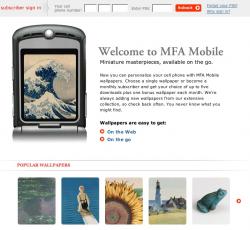
In another example of the inside-out museum, the Museum of Fine Arts Boston has made collection-based mobile phone wallpapers available from their web site. Just Browse, Order and Download, and the fee appears on your mobile phone bill: $1.99 for a single download, or $4.99 a month to get 5 (plus one bonus).
You can also sign up for text alerts about what's on at the museum: events, exhibits and concerts, as well as exclusive offers and discounts. Who could resist that!
i think i was joking about tea on Seb's Chumby -- but now I want a picture of a phone on my phone ... Is there one in the BMFA collection guys?
/jt
MW2008 Proposal Review: Offers out this week
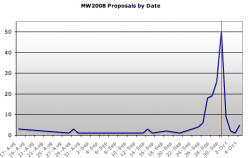 The International Program Committee has completed their review of Museums and the Web 2008 proposals, and this weekend David and i sat down to put together the conference program.
Per usual, all of the proposals came in right at the last minute (see the graph). We wondered if not mailing a physical "Call for Papers" postcard this year would have an impact (Did you notice that you didn't get it?).
There were fewer proposals this year (~150 instead of ~180 last year), but we can't negate the 'San Francisco effect'. MW2007 was a bigger meeting all around.
We certainly didn't see any change in quality. If anything, some of this year's proposals seemed a bit stronger, more well reasoned.
Program Review is always very challenging. There is a lot of good work, and many more proposals than we can include on the formal program. As we struggle to put together the schedule, we're balancing a number of factors, including the:
steve.museum term review: lots of useful tags
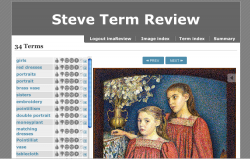
At the steve.museum session at MCN we devoted a significant amount of time to "Term Review" –– what we're calling the qualitative study of tags by professionals from participating museums within the context of the steve.museum research project. It fed really nicely into a discussion at the project team research meeting post-MCN.
For some, the very possibility that tags contributed by taggers of works of art might be reviewed by museums is antithetical to the ethos of user tagging. But, within the context of steve.museum it's essential for developing our understanding of the contribution that tagging and folksonomy might make to the accessibility of works of art on-line.
How, for example, can we respond to our colleagues' concern that tags will be inaccurate | misleading | misspelled | mis-guided, if we don't look at them and see if they are? How can we say that they might be useful, if we haven't looked?
at MCN in Chicago: museum image licensing
discussion in the image licensing session is re-hashing a number of issues we've been thinking about for a long time: