You are hereThinking about exhibits thoughts on museums, content, design, and why they matter [Ed Rodley]
Thinking about exhibits thoughts on museums, content, design, and why they matter [Ed Rodley]


Drinking About Museums: Boston! 7/23 @ Area 4, Cambridge
July 19, 2013 - 4:44pm Hey kids!
Need something to help cool down? Nothing cooler than hanging out with your favorite DAM cool people *and* special DAM guest, multimedia producer extraordinaire Robin White Owen(@rocombo) up from NYC.
When: Tuesday, July 23 at 6pm
Where: Area Four (same as last time)
500 Technology Square, Cambridge
Tell your friends!
Filed under: Thinking tools


Categories: Museum [Tech] Blogs + Stuff
Ice Cube & AFP: What makes for successful narrators?
July 15, 2013 - 8:00amWe’re getting ready to host LACMA’s California Design, 1930–1965: “Living in a Modern Way”
exhibition in the Spring, so we’ve just begun talking about our interpretive strategies and exhibition design. As I started screening the videos that were produced for the exhibition I was reminded of one of my favorite museum advertising campaigns; Pacific Standard Time’s use of the rapper Ice Cube.
Ice Cube and the Eames

image linked from kootation.com
It’s more than just a nice ad. To appreciate it, you have to watch his celebration of Charles and Ray Eames. It’s only 2:16. Watch it now, OK?
In two minutes, he gives you a sense of his connection to California, art, architecture, and design. He drops the little bomb that he studied architectural drafting, so he knows something about the subject, and he’s able to draw parallels between what he does and what the Eames were doing, bringing in mashups and sampling. It’s authentic, it provides an interesting insight into both the Eames and Ice Cube, and it’s enjoyable as hell to watch. “That’s going green 1949 style, bitch! Believe it!” Priceless… Watch it again if you want.
Beth Lisick and Alexander Calder

from http://www.magnetmagazine.com
After annoying everybody in the office with insistent calls to come into my office and watch it, I started trying to unpack why I liked it so much, and recalled an earlier piece that I think I like even more. To go along with a Calder show they did back in 2006, SFMOMA commissioned Bay Area spoken word artist Beth Lisick to do a short piece on Calder for their podcast series. This one’s short, too, and both a brilliant work in its own right and great, intimate take on Calder that isn’t didactic in the slightest, yet manages to work a lot of content into only a couple of minutes. Start at around 13:02 and enjoy an imagined evening with Beth Lisick and Alexander Calder.
Podcast with teeny, iPod-sized images
Podcast with just audio
I liked this so much the first time I heard it that I bugged a rather bemused Peter Samis to pleeeeaaaaase give a copy of that clip. It stayed in heavy rotation in the spoken word list on my iPod for several years. The concept, the writing, her delivery, even the background music, all worked to tell a tight little story, full of emotion. I can’t imagine what the first meeting must’ve been like when they read the script. “You’re ordering Chinese food and asking Alexander Calder if he wants to put on sweatpants? Umm….OK.” But it works so well to bring Calder to life for a couple of minutes, to humanize the great artist and turn him back into a person who might’ve come home one night, tired and hungry, and had someone waiting at home for him to tell her about his day.
After this segue, I realized that instead of being two things I liked, they might share some attributes that would be worth analyzing to see what common threads link them. I thought back to all the other celebrity media appearances I’d seen or heard that I liked, from breathy Jessica Tandy voiceovers, to Jeremy Irons’ smooth pronunciation of “Wenudjebauendjed” in an Egyptian archaeology show. And I only came up with one more example that really stood out as particularly inspired.
Amanda F**king Palmer (AFP) and Edgar Degas
from boston.com
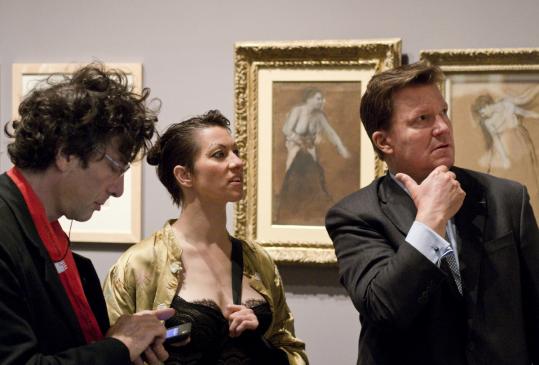
The Museum of Fine Arts in Boston did an exhibition called “Degas and the Nude” a couple of years ago, and had local singer-songwriter Amanda Palmer narrate the audiotour. It’s an inspired choice. Unfortunately, the MFA’s tours are only available on-site (boo!) for a rental fee so I can’t share any of the performance with you. I reviewed the exhibition back when it opened, and Palmer wrote about her take on being an audiotour narrator in a long post that is NSFW towards the end.
The choice of Palmer might seem odd at first blush. What does a punk cabaret singer have to share about a French Impressionist painter? Quite a lot, it turns out, because Palmer was an artist’s model in her student days, so she knows a lot about being nude in front of an artist, and the relationship between artist and subject. Take my word for it, it was a great tour.
So what do these three very different interlocutors do that works so well?
They bridge the gulf between audience and expert
One thing I think all three do an excellent job of doing, is placing the narrator in the position of helping the audience approach the subject. Unlike a subject matter expert like a curator, or another expert in the same domain, they stand in between the completely uninitiated and the cognoscenti, and provide a scaffold for us to learn more and move closer to the subject. Ice Cube knows a bit, but not a lot. He contrasts the Eames’ House with McMansions. Palmer isn’t a painter, but she modeled for them. Lisick places herself in the position of someone living with Calder who’s heard all the stories, but doesn’t seem to be part of the Surrealist world.
They bring interesting expertise of their own
Both Ice Cube and Amanda Palmer have actual credentials that allow them to have a different relationship to the subject matter than the audience. Ice Cube may have only studied architectural drafting for a short time, but it’s enough. When he’s talking about prefab wall sections and off-the-shelf windows, you can feel his appreciation for the Eames. When Palmer talks about nude modeling, you can almost hear the hours of standing still, and carry that into the paintings and imagine the process of their creation.
They personalize the subject matter
Back in the day when I worked on audiotours, one of the things I hated about using celebrity narrators was that they were being used for their name recognition, their voice and nothing else. Nothing of the performer came out in the performance. These three pieces all provide the audience with not only insight into the subject matter, but insight into the performer as well. It’s like two for the price of one!
They’re not just reading lines
It’s obvious, but it has to be said. I’ve been through a spate of unfortunate museum videos recently, where some well-meaning curator or director delivers lines like, “We’re very excited to welcome you to…” in a solemn monotone to kick off a video. Painful stuff. Successful narrators can deliver crappy lines and make them engaging. Crappy narrators can kill the best written script. A great narrator with a great script, like the ones above? Magic!
Got any other examples like these? Send ‘em my way!
Filed under: Design process, Reviews Tagged: AFP, Alexander Calder, Amanda Palmer, audience, audiotour, Beth Lisick, design, exhibitions, experience design, Ice Cube, writing


Categories: Museum [Tech] Blogs + Stuff
Swaps, residencies, and sabbaticals: Part Two
July 1, 2013 - 12:55amIn my first post on this topic, I talked a little about some of the inspirations for wanting to consider ways to go out and get new skills, and to bring in new skills. In this post, I want to look at two models and propose an idea for a platform to encourage museum staff exhanges. Details on it may follow in a later post. But before we get into the nuts and bolts of models, let’s take a moment to consider the big picture and why staff exchanges, reisdencies, and sabbaticals are important things.

from Flickr user _SID_ (CC BY-NC-ND 2.0)
Purpose of staff exchanges
The purpose of a staff exchange is provide an educational experience for both the travelling staff and the host museums’ staff. First and foremost it’s professional development, not a perk or a junket. In the models I propose below they deliver that development by providing opportunities for staff to work at other museums on projects that are relevant to their work at their home museum. Travelling staff gain new insights into how other museums approach their work. If the museums are in different countries, the international aspect gives participants an additional cultural immersion than they wouldn’t have in another museum in their county. It is an opportunity to work on familiar topics in unfamiliar settings and reflect on how different museums approach the same problems. Host museum staff broaden their experience by working with staff from other museums. And both staff and museums strengthen and broaden their ties to the larger museum community through these exchanges.
The direct exchange model
This model is pretty old-school and envisions a pair of museums that each agree to host staff from the other. In the Boston-London example, a length of stay of about six to eight weeks seemed to work well. I would propose that the museums take turns hosting, so there is never more than one person in transit at any time. Finding a mutually convenient time for two institutions to give up a staff member would probably be difficult. An asynchronous exchange would provide the greatest flexibility to the museum sending a staff member to pick the least disruptive time for the institution. I would also propose that the museums select administrators at their institution who would not only designate which staff were eligible to apply, but also could propose specific skill sets or expertise they needed for a project, so that the exchanged staff person could be of the highest value to the hosting organization.
In considering this model and in conversations with colleagues, one point has come up repeatedly. These kinds of unfocused initiatives tend to only survive as long as the people who initiated them remain at the museums. To do a general staff exchange, you need to have champions. When they move on, the relationship tends to wither. Maybe that’s OK. Not every initiative needs to last forever. A way to address this concern would be to shape the entire program around some larger common strategic goal of interest to both partners. One way to look at either of the models proposed above would be as a part of an educational initiative or content area of interest, like climate change, or sustainable engineering, or making, which each partner was already developing projects for. Exchanged staff could work on projects at the other museum that could directly inform their work back home, and each museum would benefit from the cross-fertilization.
The distributed peer-directed platform
Staff exchanges between two similar institutions are obviously valuable professional development experiences, but they have limitations. Finding the right partner being the foremost, and then getting the institutional buy-in to commit to a multi-year project that will undoubtedly cause disruption to the normal operating of the museum. There is merit to looking further afield for models and Web 2.0 platforms like Craigslist have definite potential to maximize the potential reach of the program without requiring a large baked-in bureaucracy to administer the program. The U.S. and UK governments havesponsored exchange programs in the past that have broad reach. They also require program officers, vetting protocols and elaborate application processes, all of which cost money. What if one were to envision an exchange program as a skills marketplace for member museums, where interested staff (after receiving institutional permission) could post their skills and the other museums could select staff that met their needs. Think of it as a very specialized version of Craiglist, where users could browse institutions looking for staff and staff looking for institutions. Instead of women and men, you’d have museums and staff. This model should require far less overhead and place most of the burden on the staff seeking an exchange opportunity. The platform becomes a bazaar, where we hawk our wares, and hunt for just the right kind of person.
This model would be more of a departure for the field, and more of a challenge, but it also has the advantage of being more inclusive, more cost-effective over time, and more staff-directed. For whoever hosts the platform, it also becomes a demonstration of their intention to take the lead in transforming how to think creatively about what museums can and should do to better serve our audiences.
In the next post, I’ll dig a little deeper into what such a platform might look like. Until then, I’d love to hear your thoughts on exchanges. Plausible? kooky? Sustainable? Would any museum participate?
Filed under: Design process, Professional Development Tagged: exchange, platforms, professional development, residency, sabbatical


Categories: Museum [Tech] Blogs + Stuff
Swaps, residencies, and sabbaticals: Part One
June 20, 2013 - 11:02pmI’ve been thinking about skills, staff, and creative ways to address the mismatch that we often wind up with in our museums. You’ve probably seen these situations; the lone developer or educator, doing two or three persons’ jobs because they love it so much, and never getting any opportunity to gain new skills or insights. Or the veteran who did great work but burned out, and is now underutilized in lieu of getting a chance to really recharge.
This is especially relevant to me at the moment because we are looking to hire a user experience (UX) designer to work with our lone developer on a plethora of projects. PEM, like most other museums trying to hire this kind of talent, is having zero luck thus far. If you know anybody, send them to the job description and encourage them to apply, OK? Thanks! If there was some way we could borrow one of the many talented designers I know for a few weeks, oh, what we might accomplish!
So what to do about these mismatches? They’re wicked problems, but they’re not insoluble and here’s how I know.
Residency programs
I had lunch last week with Kris Wetterlund of Museum-Ed, who is in town as Educator-in-Residence at the Isabella Stewart Gardner Museum in Boston. I went over to the Gardner to see their marvelous new addition, and to catch up with Kris and the folks at the Gardner about what they’re working on.

The Gardner’s new performance space. It’s pretty incredible.
I was intrigued by the concept of an educator residency program, and wanted to find to more. They have an active residency program as a sort of homage to their founder, who as a wealthy patron offered residences to artists and musicians. The Museum now not only hosts artists-in-residence, but an educator-in-residence each summer. She’s been writing about it on her blog. You should read it.
The residency is an interesting proposition that seems to pay off for both parties. The Gardner gets to make use of Kris’ many talents and provide some high-quality professional development for their staff. Kris gets to get away from it all, immerse herself in a new environment, and have time to work on her next book.
Staff Exchanges
This reminded me of a program that the Museum of Science had with the Science Museum, London back in the 1990s. That program assigned staff from one museum to a current project at the other museum that lined up roughly with their expertise, for a period of 6-8 weeks. Salaries continued to be paid by the staff member’s home institution, so the main expenses were airfare and living. Museum staff were very generous and creative about hosting arrangements, so it was relatively affordable for the traveling staff, and was broadly perceived to be a valuable and rewarding enrichment experience. In fact, I never heard a bad thing about the program from anyone who took part in it, and it went through several rounds before petering out.
In the next post, I’ll share some of thinking I’ve been doing with a group of colleagues for the past year or so on a model for self-organized, peer-directed platform for staff exchanges. Stay tuned!
Filed under: Thinking tools


Categories: Museum [Tech] Blogs + Stuff
Drinking About Museums: Boston – June recap
June 15, 2013 - 10:21pmJune’s Drinking About Museums was big hit! We had over 25 people show up at Area Four, and many good conversations were had over drinks and food. Hats off to you brave newcomers (Mic and Emily, I’m looking at you) who showed up without knowing anyone. We hung out til almost 10PM, always a good sign.
Museums Showoff received a near-unanimous vote of approval from the crew, so we’re gonna try it! the only question is when. Summer is coming and attendance usually drops as folks go on vacation. So the big question is do we try a Museums Showoff event now, or hold off til September and try one once the school years is back in swing. Stay tuned…

We aren’t nearly as demonic in person.


“Three hundred twenty-six, twenty-seven, twenty-… No, wait…”
Filed under: Meetup, Professional Development Tagged: drinkingaboutmuseums, meetup, Museumshowoff, professional development


Categories: Museum [Tech] Blogs + Stuff
Reminder! Drinking About Museums:BOS is tomorrow!
June 12, 2013 - 6:31pmI’ve posted it below, put it up on the Google+ site, tweeted it at you, and updated my LinkedIn. Tell your friends! And join us at Area Four for excellent company and plotting!
We’ll even have a surprise special guest, Kris Wetterlund (@MuseumEd), Educator in Residence at the Isabella Stewart Gardner Museum!
Filed under: Meetup, Professional Development Tagged: Isabella Stewart Gardner Museum, Kris Wetterlund, Museumshowoff, professional development


Categories: Museum [Tech] Blogs + Stuff
June Drinking About Museums: Boston!
June 1, 2013 - 4:46pm
“Name that cup!” from Flickr user aka*kirara CC-BY 2.0
Greetings, comrades! Boy, does it feel like Summer! My last post on the history of Drinking About Museums: Boston seemed to generate a bit of interest, so let’s capitalize on it! Thanks to the efforts of the ever-diligent Jenn Schmitt, our next Drinking About Museums: Boston will be:
Thursday, June 13th – 6:00 pm at
Area Four – 500 Technology Square, Cambridge
We’ll be venturing back to the wilds of East Cambridge, but to a new venue. It’s still convenient to the T, and there’s even Free Parking (see their website for details)!
Topic of Discussion: Museums Showoff
This month, we’v got a little homework for you. Go visit Museums Showoff and see what you think. That’s all. Look at the site and think about it. Easy, right? Hardly work at all! I’m very intrigued by the idea and think it might be a fun experiment to give people a chance to share things they’re excited about! The Lightning Talks at MW and the Ignite talks at MCN have been some of my favorite experiences of the past few months, and there’s nothing hanging around drinking and listening to your peers talk about what excites them!

Rosanna Flouty’s awesome MCN2012 Lightning Talk, with cheese curds, no less! by Flickr user mp_eds (CC-BY 2.0)
At least, that’s what I think. What matters, though, is “What do you think?” Would you stand up at such an event, or even come to one? I’ve spoken to a few people who seem interested, so if enough of you are game, Jenn and I are willing to make one happen.
Please RSVP by June 11 so we can make a reservation. They are happy to handle a big group, we just need to let them know how many will be coming. Jenn says the pizza is amazing!
See you there! And tell your friends!
Filed under: Thinking tools


Categories: Museum [Tech] Blogs + Stuff
On “Drinking About Museums”
May 26, 2013 - 8:23pmI’ve gotten a few request lately from folks wanting to know, “What is this “Drinking About Museums” and how do join/start one in my town/find out more. I’ve sent out descriptions via email in the past, but I guess I’ve never posted anything, so here is both a brief history, and a bit of the philosophy behind how we do Drinking About Museums in Boston. Your mileage may vary.

CC-BY image by Flickr user Mr Kael
HistoryDrinking (by which I mean informal, after-hours socializing. Alcohol is obviously optional) and museum work have a long history. If you’ve been in the field for any length of time, or been to even one museum conference, you will have noticed how much we like to talk about our work and hear what our colleagues are up to. Cities with large concentrations of cultural heritage organizations like NYC, Washington, London, etc… have long had informal groups who’d get together and drink and commiserate. For me, I find out as much at the evening events at a conference as I do at the sessions, sometimes more. A constant refrain at the end of a good conference would be the heartfelt goodbyes as people said goodbye until next year.
Two years ago at Museums and the Web, a bunch of us were sitting around the hotel bar, doing the end-of-conference “I’ll miss you guys!” when Jesse Kochis said, “You all work around Boston, you could just get together!” and said he’d find a place if I’d collect email addresses. So in May, 2011, a group of people descended on the Eastern Standard and we had our first meetup. The name went through many unfortunate iterations, like “Boston Museum Geeks” and “Boston Museum Tech Meetup Group” and at least one other I’ve blocked out. A few months later, I heard from Koven Smith in Denver that they had a Meetup group they called “Drinking About Museums” and I said, “Oh, that’s perfect! Can I steal that name for our group, too?” Being straight-up, generous folk, Koven and Kate Tinworth, who run the Denver group gave their blessing, and the name expanded to Boston.

Jim and Kristin getting animated, while Ed ignores them.
#drinkingaboutmuseums FTW!The power of a good idea is impressive to see in action. #drinkingaboutmuseums starting appearing on Twitter. Within months, there were Drinking About Museums announcements popping up in D.C., Sydney, Melbourne, S.F. and more places. There is now a Google+ group where you can find where Drinking About Museums is happening around the world. It’s been gratifying to watch, and kinda strange to become associated with a brand.
I used to email everybody, trying to find a time that worked. It was a huge time suck and I was bad at it, too. Eventually, I stopped trying to find a time for everybody and just picked mid-week nights that worked for me. Even the email list management proved to be a real job. I tried to do all my notifying by Twitter and on the blog, but that didn’t work out well. Luckily, Jennifer Schmitt from deCordova Sculpture Park and Museum volunteered to handle the list, and has done so admirably. Koven also set up a Google Plus group, which has been a great aggregation site for DAM activity.

Jenna and Lynn with the paper prototype of their multitouch exhibit
Drinking About Museums: BOS
So here’s how our group currently functions.
It’s a coalition of the willing at the moment.
If you want to take on a larger role, come on in! For several months running, we went to different museums each month, and had behind-the-scenes tours of things that members were working on. People did presentations. One month, a member needed a test audience for a workshop on game design she was making. Other months, it’s just social. We get together and enjoy each others’ company. It gets as big and as small as it’s most active member wants it to. I’m currently obsessed with trying out a version of Museums Showoff in July if I can find a venue. Who knows we’ll do in the future?
It’s a completely open group at the moment.
That was both a philosophical choice and a workflow choice. I didn’t want to be a gatekeeper and decide whether someone belonged. I ddin’t want to field requests to join. Koven and Kate have Denver set up as a closed Meetup group that you have to apply to join. If you’ve got the bandwidth to tailor the group to your needs and wants, that might the best option for you. Being completley open worked for us. It means sometimes people come who know noithng about museums but are interested in culture in general. I still field requests, so that didn’t change.

Drinking About Museums: Melbourne
It’s museums focused at the moment.
My own biases came to the fore when I was in Australia last summer. I got to go to TWO Drinking About Museums in two weeks in Sydney and Melbourne, and the Melbourne group was more broadly GLAM-oriented, than just museum focused. It was really interesting to hear about the isssues librarians and archivists were having and how they were similar/dissimilar to mine.
The logistics
When we’re ready to have a new Drinking About Museums:Boston edition, here’s what happens.
Pick a date
Jenn and I will chat publicly about place and date on Twitter. If anybody joins the conversation, we’ll loop them in. If not, the two of us will pick a place and time. If somebody has agreed to host, then we all try to find a night that works. I’ve never gotten a Friday night event to work. Don’t do it.
Tell the world!
The first rule of Drinking About Museums is…
Unlike Fight Club, the first rule of Drinking About Museums is to get the word out. Jenn sends out an email to the list, I blog about it, advertise it on Twitter and post it on the Google Plus group. If you want people to come, you have to talk about it. I used to worry about talking too much about it, but I haven’t found it to be an issue. And those months when three people came? Yeah, they kinda coincided with months I didn’t do much promotion. Go figure…
Send out reminders
Get to know the folks at the venue
If you’re going to a bar or restaurant, it’s worth letting them know in advance that you’re convening a group there. Some places will let you know in no uncertain terms that they’d prefer a group where everyone is buying dinner, not standing around nursing cheap drinks. Other places will be happy for the business, especially if you tell them you meet regularly and you meet on a night that isn’t a busy weekend night.
Get there early
Let the venue know you’re there and where you’ll be so they can send people over. I’m “that museum group guy” at several Boston-area establishments.
Meet everybody and take names
Seems like a no-brainer, but I had to train myself not to immediately grab a drink and dive into a conversation with my friends. Especially with an open group, there will people who show up and know nobody, brave souls. Making them feel welcome and giving them that first connection to the group is important. Also, we need to maintain our email list to make sure we capture new people contact info.
Solicit ideas from the group
The people coming to a Drinking About Museums are obviously motivated and wicked into museums. They have been the source of some of our best ideas, from hosting us at their institution, to using the group as an informal focus group, to showing off exciting new work. Put the group to work!

Game creation workshop!
Be experimental
Mixing things up has worked well for us. After a string of just social events, we went on a several month long binge of visiting area museums and then adjourning for drinks. Lately, we’ve been having special guests. Maybe our test of Museums Showoff will be such a success that we make it a regular feature. Who knows? Come and find out if you’re in town!
Filed under: Design process, Meetup, Professional Development Tagged: Boston, Denver, design, Drinking About Museums, experience design, Google, Melbourne, Museums and the Web, professional development, twitter


Categories: Museum [Tech] Blogs + Stuff
A quick question for you
May 5, 2013 - 9:58pmHot on the heels of our fascinating plenary at Museums and the Web about Sleep No More and immersive theatre and museums, I went to a very different kind of immersive experience – 20,000 Leagues Under the Sea – an immersive, puzzle-based, interactive experience developed by 5 Wits, who also did Operation Spy at the International Spy Museum. It’s sort of the polar opposite of SNM; family-friendly, group based, and very explicative. And it worked on a number of different levels than SNM. Particularly the game-based elements of it. So I’d like to conduct an experiment with your kind condescension.
Think about the experience of being in museums and why you like them.
Now think about games you love. Board games, videogames, whatever…
Holding both those in mind, can you put them together and tell me what you see?
Which games sprang to mind? Why?
Filed under: Design process Tagged: design, games, gaming, immersive theatre, storyworld


Categories: Museum [Tech] Blogs + Stuff
Museums and the Web 2013 thoughts
April 28, 2013 - 11:53amMuseums and the Web 2013 in Portland Oregon was an action-packed few days of intense conversations and great food for thought.

Portland food trucks. You just can’t go wrong.
Danny Birchall and Susan Edwards have both written great summaries of their experiences at the conference and I recommend both. It’s always fascinating to see how varied people’s experiences of the same event can be, and also how some of the same idea wind up poking through everyone’s sessions.
Games, gamification, and play in museums
If you’ve read this blog for any length of time, you know I’m not a huge fan of gamification (ack!). The series of posts I wrote last year have continued to be perennially popular, no doubt due to high frequency of buzzword usage in them. Start here if you want to read them. The gaming session led by Bruce Wyman, Sharna Jackson and Kate Haley-Goldman was a delight to be in. The speakers know games, make them, study them, and they were able to turn a critical eye to the current popularity of slapping badges and leaderboards on anything and everything and separate some wheat from the gamified (ack!) chaff. I was glad to hear people highlight the distinctions between games and gamified (ack!) activities and play, and the back and forth between the audience and the speakers was high-energy and high-quality. This talk was a great grounding for Rob Stein’s excellent update on DMA’s new free membership program, DMAFriends, which seems to be a very successful application of game mechanics to a traditional museum loyalty program. More on that later…
Immersion and affection, or relationship-building
One of the great joys of these events is the extent to which we don’t talk about technology. For me, one of the persistent themes of the conference was connecting with our audiences on an emotional level. Larry Friedlander’s opening plenary, When the Rare Becomes Commonplace: Challenges for Museums in a Digital Age, started off quoting Psalms and Shakepeare before launching into emotional appeals to connect with people in meaningful ways. You should watch it. Dana Mitroff Silvers led off her session on design thinking by saying that a design thinker’s first task is not to understand, but to empathize with who they’re designing for. There’s also a website now for design thinking in museums. Luis Mendes, in his brilliant lightning talk, wondered why there were so many books on anger management but none on what he called affection management. His thesis about the centrality of relationships and building structures to grow them often referenced digital technologies as tools to achieve this, but only as tools. “I do believe these are the days of miracles and wonders, and the signs are popping up everywhere.” Yes, indeed!
This drumbeat of emotional appeals echoed a number of conversations I had about immersive theater throughout the conference. I’ve written about Sleep No More before and alternative models of exhibition development, and I’m no nearer to clarity than I was when I started, but other people are wrestling with the same concepts, which is heartening. And my major a ha moment of the conference came after talking to Suse Cairns about her experience of SNM, which involved stalking an actor, getting dragged off into a secret chamber, unmasked and stuffed in a closet while having poetry spoken to her. It also involved being given a gift – a locket she brought with her to the conference as a token of her experience. I won’t try to do her story justice, suffice it to say that it was deeply meaningful to her and connected her to the action and actors in a way I didn’t experience. And that allowed me to see that I’d been focusing on the wrong part of immersive theater – the immersion – when what was powerful was the emotional connection and the immersion was just a mechanic for encouraging that.

Suse’s locket. The paper is full of seeds. Ask her about it.
Ending with a bang
I was part of the closing plenary on immersive theater with Seb Chan and Suse Cairns (heaven!) along with Diane Borger, producer of Sleep No More, who joined us via videochat from locked-down Boston, which was another theme of the conference I won’t get into here. Seb did a great job of drawing parallels between how a theatrical event like SNM gets created and big museum traveling exhibitions. It was interesting to compare the per square foot costs of both and how long each took to recoup their initial investment. Sleep No More won. Hmm…
Also, all three panelists, as well as many in the audience had a common experience of having a hard time getting into SNM. This idea of having to work hard to get into something seems kinda crazy and the opposite of how museums function, but I can’t help wonder if building that kind of anticipation has value in our work. Must ponder…
All in all, an hour was went by way too quickly, and I don’t think we did more than launch the opening volley in what I hope will be a much longer, more fruitful conversation. I love the way this cohort is willing to look outside the field for inspiration while retaining a critical eye, and I hope by next year one of you will have something interesting to report on.
What was your experience of the conference, locally or remotely? Were there themes that arose for you? I’d love to hear about them!
Filed under: Thinking tools


Categories: Museum [Tech] Blogs + Stuff
Gap week!
April 9, 2013 - 10:55amFor the first time in longer than I can recall, I have nothing I have to do for work. I’m between jobs, having what a friend decided to dub my “gap week”. Instead of unpacking my boxes from my old office, or spending all day reading up on the strategic plans of my new employer, I’m reading stuff I’d squirreled away, sometimes years ago that I thought I’d “get around to” in quieter moments. Susan Stewart’s “On Longing: Narratives of the Miniature, the Gigantic, the Souvenir, the Collection” is one of the most remarkable books I’ve read lately. It’s written in a dense, but lyrical style, in the way that only a literary critic/poet could write. More on her later.
I also finally reread Adorno’s “Valèry Proust Museum” essay and the opening of that leapt out and smacked me,
“The German word museal [museum-like] has unpleasant overtones. It describes objects to which the observer no longer has a vital relationship and which are in the process of dying.”
And that’s just the beginning! He goes on to compare art museums to sepulchres and much, much more! There’s a lot more to unpack in there, but for some reason this statement about vitality made me think about why I get so excited about digital technologies in museums. A lot of that excitement has to do with their potential to create new kinds of connections between people and places and objects. Here’s one quick example of how.
Months ago, Britanny Beck from MyOrpheo shared a sweet little story with me that encapsulates a lot of what excites me about digital technologies and heritage. It’s a simple story, involving a guy, a gal, a historic building, and an audiotour.

The Clock, courtesy of MyOrpheo
Adam and Erica live in New York City. Erica’s favorite place in town is Grand Central Station. On one of their dates, they took the new audio tour of the station, which Erica loved. Adam decided using the audio tour would be a perfect way to ask her to marry him. He contacted Orpheo and pitched the idea of replacing one track on the tour with his proposal and then giving her a special unit with the new tour on it.

Let’s take the tour!, courtesy of MyOrpheo
Being very good sports, MyOrpheo agreed to cut a special track and Adam was left with the job of arranging a plausible reason to take the same tour again. That’s what friends and family are for, right? So, Erica’s brother and sister-in-law conceived of a sudden burning desire to take the audio tour of Grand Central, and Erica fell for the idea of it being a double date. When she and Eric got to Vanderbilt Hall, instead of getting information on the room and its architecture, she got a marriage proposal. Eric got down on one knee, and the rest was history. Well played, Eric. Well played.

The special audio track, courtesy of MyOrpheo
The relative ease with which one can customize digital media and the ability to create personal experiences are truly revolutionary. As is the shift in mindset of organizations to be able to even consider letting people appropriate their tools for their own ends. That’s worth getting excited about!
Filed under: New Media Tagged: adorno, Audio tour, Customization, Grand Central Station, Museum, MyOrpheo, Personalization, Susan Stewart


Categories: Museum [Tech] Blogs + Stuff
US OpenGLAM workshop!
April 2, 2013 - 1:25pmHey, I guest blogged over that the OpenGLAM website on a workshop I attended last week in Berkeley. Expect to see more about this in the coming months (hint, hint!)!
Filed under: Thinking tools Tagged: new media, openGLAM


Categories: Museum [Tech] Blogs + Stuff
What can museums learn about immersive theater?
March 30, 2013 - 3:39pm
Solitude of a Darkened Life by Flickr user @Photo
One of the most unexpected outcomes of taking a new position was my new boss asking me if I was interested in attending Museums and the Web 2013. I’ve been going to MW as often as possible since the late ‘90s, and never fail to come away rejuvenated and full of new ideas. Most of the people I consider my closest professional peers are folks I first met at MW. So I said, “Yes, please!” and am counting down the days til I arrive in Portland.
I’m excited to attend for many reasons. This will be my first conference as an art museum professional so it’ll be interesting to see what sessions and speakers now seem valuable/relevant/important to me in my new role. I have a lot to learn, and I hope to take away a lot.
Museums and the Web is the bookend conference for the Museum Computer Network conference, and a great deal of planning and plotting will take place at MW2013 that will influence the shape of MCN2013. It’ll be great to be there for those conversations.
Since I wasn’t expecting to go this year, I paid no attention to the program until recently and therefore am not chairing a session, presenting a paper, running a workshop, etc. I can go and hang out and soak up the event, and that feels like a real gift. Thank you PEM, and Jim!
I didn’t get off completely scot-free, and that’s what this post is going to be about. I wrote some time ago about going to see Punchdrunk’s Sleep No More in NYC, as have others. It turns out the Diane Borger from Punchdrunk is going to give the closing plenary on immersive theatre and museums, and I was invited to join the panel with Diane, Seb Chan, and Suse Cairns! I am tremendously excited to be part of what could be an important community discussion and have been reading up on immersive theatre and thought it’d be worthwhile sharing some links for those who don’t yet know what immersive theatre and why it’s something museums might learn from.
Recent immersive theatre & museums articlesWhat can museums learn from immersive theater? | Museums and the Web 2013
Diane Borger is the producer who brought Punchdrunk’s Sleep No More to the US in 2009 (http://www.americanrepertorytheater.org/events/show/sleep-no-more). After an extended, sold-out run, the immersive theater production moved to New York, where it continues to play today (http://sleepnomorenyc.com). Please join Diane and Punchdrunk’s many museum fans and critics for an inspiring discussion of what museums can learn from immersive theater led by Seb Chan, Ed Rodley and Suse Cairns. We are all sure to be transformed by the experience!
Mark Dion’s “Curator’s Office”
Mark Dion, ArtForum
In ”Curator’s Office”, books, furniture, and personal effects do not reveal their collector’s taste or knowledge, but rather spin a fictive tale about a curator gone missing in the 1950s in a period of American anticommunist paranoia.
ht to Robin White Owen (@rocombo)
The Psychology of Immersion in Video Games
by Jamie Madigan
Though it is focused on videogames, I think most (if not all) of it is relevant to both immersive theatre and to museum experiences. The unpacking of immersion, or “presence” as its called in the psych literature I found very helpful.
ht to Suse Cairns (@shineslike)
A Waking Dream Made Just for You
By Chris Colin, New York Times
Perhaps the most extreme example of immersive theatre I’ve heard of yet; a production hand-crafted and personalized for an audience of one.
Lithuania’s Soviet nostalgia: back in the USSR
by Dan Hancox, The Guardian
Feeling nostalgic for the good old Soviet Union? Then head to Lithuania, where several theme parks let visitors feel exactly what it was like – right down to scary, abusive guards.
Immersive theatre and the anxiety of choiceBy Tara Burton, New Statesman
Immersive theatre is about turning the traditional power dynamics of actors and audience on their head. One potential outcome of that is anxiety in the audience. This certainly resonated with my own experience of Sleep No More.Is theatre becoming too immersive?
by Alice Jones, The Independent
Alice has been put on the spot by actors time and again – and she’s sick of it
Interactive theatre: five rules of play from an audience perspective
by Miriam Gillinson, The Guardian
A useful little breakdown of how immersive theatre can let down their audiences.
How I learned to love immersive theatre
by Mark Lawson, The Guardian
This example of site-specific and non-text-based theatre, Robert Wilson’s “Walking”, sounds amazing, and since it relies on the landscape, seems like it could have utility in a museum setting, where the setting itself is often an object to be interepreted.
Though a lot of immersive theatre seems to lean heavily on adult themes, this Young Tate performance, staged around Tate Liverpool’s “Alice in Wonderland” exhibition, goes more for a ”darkly playful and absurd experience”, as it invites the audience to journey beyond the exhibition and through the looking glass.
Any other great examples I’ve missed? Let me know!
Filed under: Design process, New Media, Professional Development, Reviews Tagged: audience, experience design, immersive theatre, MCN2013, Museum, MW2013, professional development, relevance, review


Categories: Museum [Tech] Blogs + Stuff