You are hereLorcan Dempsey at OCLC
Lorcan Dempsey at OCLC

Three challenges: Engaging, rightscaling and innovating
July 5, 2013 - 5:12pmI was in Australia recently, primarily to attend the conference intriguingly entitled 'The edge of the world'. The presentation I gave is here, and is embedded below. This was the latest Theta conference, the Australian parallel to Educause. I very much enjoyed the host city, Hobart, not least because of the smell of the sea as we walked out of the hotel.
More recently, I was pleased to attend parts of the CIC Center for Library Initiatives conference, hosted by The Ohio State University, here in Columbus (far, unfortunately, from the sea). The topic was emerging forms of scholarly communication.
Finally, Kurt de Belder recently gave a presentation at OCLC in our Distinguished Speaker Series, in which he spoke about the transformation of the academic library.
In Hobart, after some introductory material, I spoke about three challenges for libraries: a shift to engagement, rightscaling infrastructure, and innovation, notably institutional innovation. I only attended some of the sessions at the CIC meeting but I was struck by the correspondences between what I heard there and the challenges I identified. It also seemed to me that much of what Kurt spoke about aligned well with these challenges also.
This blog entry briefly talks about each challenge and illustrates them with examples from the CIC conference and Kurt's presentation.
Engagement, infrastructure and innovation are related of course. As engagement becomes more important, libraries are reducing local infrastructure where it does not make a distinctive local impact (print collections and systems, for example). Greater engagement means that there may be a need for new services which requires innovation. Over time innovations may become established and generate infrastructure requirements, which may be provided in different ways.
Libraries always did these three things, but I think the nature of the current challenge is different. Libraries are looking at more and different ways of engaging with their users as patterns of research, learning and personal information use change in a network environment, and are actively looking to re-allocate resources to support his shift. At the same time, the emergence of the network makes it possible to chose to source infrastructure in different ways and at different levels, introducing new choices and partner opportunities.
1. The shift to engagement.
By engagement, I mean that libraries are working to create distinctive value in the research, learning and teaching workflows of their users in ways which go beyond the provision of collections.
In this context, Kurt de Belder speaks about the library as an active partner in knowledge. Scott Walter spoke recently about the service turn, a direction in which libraries aim for distinction in the services they offer, as the distinctive value of collections is less strong, and content is less scarce
And I was struck by this formulation by the University of Minnesota Libraries:
In alignment with the University's strategic positioning, the University Libraries have re-conceived goals, shifting from a collection-centric focus to one that is engagement-based. [PDF]Think of these trends:
- Users used to build their workflows around libraries. Now the library needs to build services around user workflows, especially as those workflows form around broader network services. So, for example we see libraries expose their knowledge bases to Google Scholar; introduce support for Mendeley and Zotero alongside Endnote or Refworks; reach out to provide curricular or grants support; and other ways in which they more directly support changing workflows. Kurt de Belder spoke about their support for researchers through VREs (virtual research environments), systems to support group working and research workflow (in their case, based on the Sharepoint toolkit developed by Microsoft Research).
- Libraries used to acquire and organize 'published' materials. Now they are engaged with the full range of creation, management and disclosure of learning and scholarly resources. For example, we are seeing library provide copyright, publishing, or bibliometric advice; engage with the emerging scholarly publishing practices of their faculty; explore research data management strategies; actively promote institutional research and learning outputs through the institutional repository; ... This means that promoting institutional materials on the network becomes more important.
- Library spaces used to be configured around the management and use of print collections; now they are configured around engagement with researchers and learners, around experiences, expertise, and specialist facilities. For example, libraries provide better spaces for social interaction around learning or communication tasks; they promote access to specialist data, GIS, or other expertise; and they mount exhibitions which highlight relevant aspects of special collections and archives.
One signal of this shift is the debate around the library subject or liaison role. Kurt de Belder describes a shift in Leiden University from collection specialists to outreach which is 'service and expertise based'. Liaison librarians will partner around 'data curation, copyright, text and data-mining, e-publishing and dissemination, GIS, datasets'.
Clearly, given its topic, the CIC conference focused on new forms of engagement with the faculty around curation and dissemination of research outputs, around new forms of scholarly publishing, and around publishing support and advisory services.
Four things occurred to me as I listened, specific to this particular discussion about publishing support, but which might be generalised to other emerging forms of engagement with research and learning.
- These are areas where libraries are exploring a range of services, which means that each library's approach will be different. And each library's activity will be differently situated in relationship to other campus services. This was very clear in the final panel session where participants spoke about how services were organized. There is no consistent organizational pattern, for example, for the relationship between copyright and other advisory services, library publishing services, university press, research data management, and institutional repository. In this context, I was also interested to recently see how Penn State had aligned special collections and scholarly publishing services in one division.
- It is sometimes difficult to discern between edge cases and emerging services: are alternative forms of monograph peer review and publication going to emerge as important categories for example, or will they remain experimental?
- There is a balance between doing extensive custom work for one faculty member or department and the ability to scale services effectively across a campus community.
- Emergent areas live beside established practices. This may lead to a more plural environment, or over time to disruption or absorption. Think of the various scenarios that might play out with open access publishing and alt-metrics for example. There were CIC panels in each of these areas, with participation by representatives from Elsevier and Thompson Reuters.
For me, this discussion underlined the innovation challenge I discuss below. Exploration and experiment has to turn into something repeatable and scalable if it is to become part of the library portfolio. And much of the required innovation is around the institutions through which we organize to get work done - think of the changing relationship of University Press and Library, for example.
2. Rightscaling
Libraries were predominantly 'institution-scale' - they provided services at the level of the institution for their local users. However, their users now look to the network for information services (e.g. Google Scholar, Wikipedia, ...). And libraries now look to the network to collaborate or to source services (e.g. HathiTrust, cloud-based discovery or management systems, shared systems infrastructure, ...). At the same time, we are seeing a growing interest in shared management of the collective print collection, as regional and other consortia emerge to rebalance print management across groups of libraries.
In this environment the need for local infrastructure declines (e.g. extensive print collections, redundantly deployed local systems which provide necessary but not distinctive services). The scale advantage of different ways of doing things manifests itself in both impact and efficiency. Think of HathiTrust. It has more impact, because it acts as a gravitational hub on the nework. And it is more efficient to consolidate this activity rather than spread it redundantly across many libraries.
Print collections provide an interesting example of emerging infrastructure consolidation. In seven years time, say, a large part of the existing print collection in libraries will have moved into shared management, with a reduced local footprint. The opportunity costs of locally managing large print collections which release progressively less value into research and learning are becoming too pressing for this not to happen. There is a low engagement return on this infrastructure investment.
At the CIC meeting, scale came up in several contexts. John Wilkin spoke about how the consolidation of publishing activities in one unit and the sharing of infrastructure across them allowed the separate activities to benefit from scale, and achieve a level of activity that would have been impossible if they had remained separate, scattered across the University of Michigan. Charles Watkinson mentioned that it was usual to outsource technical infrastructure at Purdue. And in his closing remarks, Mark Sandler mentioned previous discussions about a single university press for the CIC. He suggested that it might be more reasonable to explore a model in which backoffice infrastructure was shared, but where engagement with research, author relations, press identity, remained individual to each campus. In the vocabulary used here, he was speculating that infrastructure might scale to the level of a regional consortium, while engagement might remain at institution-scale.
On a national scale, Kurt de Belder spoke about the Dutch bibliographic infastructure, currently provided in partnership with OCLC. He reported discussion about whether there continued to be a need for national-sscale services in the current network envioronment, and whether in fact they should go to more global provision at the network level.
Of course, although rightscaling is an important infrastructure issue, it is not limited to infrastructure. Kurt also spoke about the lack of scale as a broader library issue. He argued that each individual library could not specialize in the range of expertise required to deliver current services. He spoke, for example, about research data management services in the context of the full range of disciplines on a campus. In this context, he spoke for national and international collaboration around networks of provision to get local jobs done.
These examples show how rightscaling has become a central question for libraries. Do I build something myself? Do I do it collaboratively? Do I outsource it to a third party? Again, look at discovery systems or library management systems in this context, or look at the trend to managing down print collections alongside emerging shared print initiatives. Think of the models in use for preservation (LOCKSS, Portico). Think of newer services like analytics or recommendations where an institutional perspective may not scale and collaborative or third party approaches will be necessary. Think of how important it is to make sure that your resolver is correctly configured in Scholar or PubMed. Questions increasingly arise around cloud provision, around collaboration, or around outsourcing to third parties.
As libraries want to emphasize impact and engagement, and de-emphasize activities which do not create distinctive local value, rightscaling becomes a key question.
3. Institutional innovation
As behaviors and structures shift, innovation becomes central.
I think of two big trends here. The first is a shift - well underway - from thinking about the library as a fixed set of services (bureaucratic) to thinking about it as an organization which reconfigures to map changes in its user environment and expectations (enterprise). The second shift is around institutional innovation and the learning that flows from it.
I wrote about the first of these shifts a while ago.
Historically, libraries enjoyed stability and a shared understanding of goals. This in turn favored a focus on managing and improving the means towards those goals - building the collection, providing reference service, creating efficiencies in technical processing, and so on. This was the focus of professional practice and education. Much of this work is inherently bureaucratic. However, in an environment of change while overall mission and values may remain the same, new and shifting goals become the norm. Think of greater integration in the learning and research process through greater curriculum support, data curation, scholarly publishing, or support for grant writing or expertise profiles. Think of network based reading services, or jobseeking and homework support. As goals shift in a changing environment, so does the need to think about how to marshall the means to meet them. This may need reorganization, new staff skills, changing priorities, reallocation of staff and resources, and so on. It requires a shift from bureaucracy to enterprise, an adaptive organization that reviews and reshapes what it does in light of changing requirements. [The Enterprising Librarian]Coping with change requires an enterprising orientation, one which recognizes that resources and effort must be continually adapted to meet the needs of the library user.
Institutional innovation is the second trend I note here, one which is inevitable as internal and external partnerships rebalance effort. Libraries have to develop new and routine ways of collaborating to achieve their goals, which involves evolution of organizational, cultural and communication approaches. At the same time they have to negotiate internal boundaries and forge new structures within institutions. In each case, they are developing new 'relationship architectures' (to use a phrase of Hagel and Seely Brown's).
Think for example of the institutional innovation required to move to shared systems and collections in the Orbis Cascade Alliance or 2CUL for example.
Or think of the innovative approach which makes new relationships within institutions (with Learning and Teaching Support, with the Office of Research, the University Press, emerging e-research infrastructure, IT, etc, for example, or with various educational or social services in a public setting). Evolving such relationships requires an enterprising approach and ensures continual learning, as staff interact with colleagues elsewhere to evolve new structures and services.
We are used to thinking of innovation in relation to startups. Here is a definition from Steve Blank: "a startup is an organization formed to search for a repeatable and scalable business model". This is useful as it reminds us that to be successful. In library terms, innovation has to result in repeatable and scalable services which can be supported over time. And this brings us back to the type of engagement that is valuable and the infrastructure that is required to support it.
Much of the discussion around the examples I have used is an exploration of how to make identified new services repeatable and scalable, and of how to evolve the skills and organizational settings to support them.
Rightscaling, engagement, learning: reconfiguring the library for a network environment from Lorcan Dempsey
Credits:
The framework used here is influenced by the categories used in Unbundling the corporation. Institutional change and learning is discussed in Institutional Innovation.
Unbundling the corporation. Harvard Business Review, 77, 2. January 1, 1999.
John Hagel and John Seely Brown Institutional innovation: creating smarter organizations to scale learning (January 01, 1999).
Categories: Related: Archives + Libraries
Names and identities: looking at Flann O'Brien
July 2, 2013 - 1:08pmNames and identities are a major focus of interest for OCLC Research. I adapt this discussion of our work in this area from the recent OCLC Research Quarterly Highlights.
We know very well that names are not always straightforward. Brian O'Nolan and Brian Ó Nualláin are the English and Irish versions, respectively, of the name of the person who is more commonly known to us as the author Flann O'Brien.
But things are more complicated. Flann O'Brien was the 'identity' he chose when writing novels in English. As the prolific author of satirical columns in the Irish Times, he was known as Myles na gCopaleen, under which identity he also wrote an Irish language novel (and it should be noted that this turns up under different spellings, Myles na Gopaleen, for example). I take it that Flann O'Brien and Myles na gCopaleen are examples of what ISNI (more of which later) calls 'public identities' for Brian O'Nolan. Of course, it does not stop here, as Flann O'Brien was also known by several other names.
More generally, even if most people's names and identities are less complicated than this, there is not a one-to-one relationship between names and people. This means that the relationship between people and their names and identities has become something that is managed in a variety of places. Of course, different choices can be made in those places. If I do a search on Wikipedia for either Flann O'Brien or Myles na gCopaleen, for example, I get directed to the page for 'Brian O'Nolan'. Wikipedia directs us to the person Brian O'Nolan, rather than to any of his assumed identities. Libraries have for a long time had an apparatus to manage this plurality: authority control. And national library authority files have different practices in how they roll names up to one or more identities.
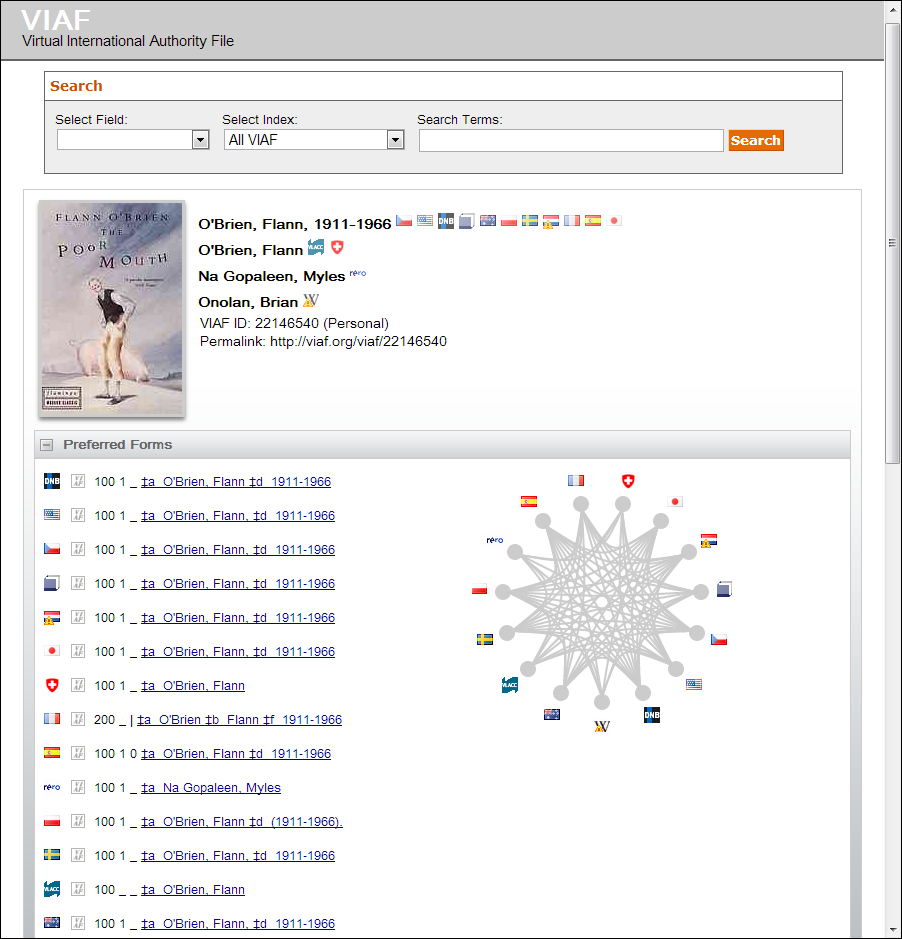
Authority control has typically been organized on a country by country basis: national libraries organize national authority files. As the network unifies information spaces globally, purely national files have less utility. Recognising this issue, OCLC Research has been working with national libraries around the world to synthesise authority files into what we call the Virtual International Authority File, VIAF. VIAF now brings together names from those files into 24 million clusters, and assigns each of these a unique ID. Matches are not made simply on name text strings--contextual data from the authority files (e.g., birth date) and associated bibliographic data are also used. Further work is being done to increase the value of this consolidated resource. For example, the VIAFbot initiative creates links between Wikipedia and VIAF, inserting a VIAF link on appropriate Wikipedia pages. And VIAF now treats Wikipedia as a contributory source, ingesting names from Wikipedia alongside names from national authority files. In this way, there is a direct, actionable link between the global, addressable knowledge base that (the English) Wikipedia has become and library files, enhancing the value of each. The Wikipedia page for Brian O'Nolan has a link to the VIAF entry for Flann O'Brien. Importantly, from this we can assert that the "thing" or "person" described by http://en.wikipedia.org/wiki/Brian_O'Nolan is the same as the "thing" or "person" described by http://viaf.org/viaf/22146540/. We are looking at other language Wikipedias also.
VIAF has quickly become a major source of data about names. It gives a unique identifier to those entities--people, organizations, and others--which are the creators or subjects of works, gathers names which designate them, and contextualizes them with associated metadata. OCLC and the participating national libraries hope to see VIAF become an important backbone reference in the emerging web of data. And for this reason, we have made it openly available as linked data.
Of course, there are also other important initiatives, notably ISNI and ORCID. As the web becomes more central to scholarly and cultural activity, and as more information work is automated, identity and disambiguation are increasingly important. People are resources which need to be discoverable, referencable, and relatable. Accordingly, names and their relationship to the people they designate has become a key interest in the cultural, educational and creative fields.
Because of our work with VIAF we are closely connected with both ISNI and ORCID. The International Standard Name Identifier (ISNI) is an ISO standard (ISO 27729) that uniquely identifies "the identities used publicly by individuals or organizations involved in creating, producing, managing and distributing content." It is managed by a consortium of national libraries, rights organizations and others. The ability to unambiguously designate a person is important in a rights environment. VIAF provided data to seed the ISNI pool of people data and OCLC provides the infrastructure to manage ISNIs. ISNIs have begun to be added to VIAF. ORCID emerges from the scholarly publishing arena where the consistent identification of researchers has always been an issue. Here again, as more services are built on the programmatic manipulation of data about publications, researchers and institutions, unambiguous designation has become a goal. OCLC Research participates on the ORCID Board and the relationship between VIAF and ORCID is being discussed.
We expect to see various relationships between ISNI, VIAF and ORCID as they evolve. Alongside this involvement in these important formal initiatives, we have some other important interests in names. These include:
- The source of information about names in the above initiatives is the creator themselves, or expert metadata creators. However, we also expect to complement this work by programmatically identifying names. We are exploring automatic recognition, extraction, and disambiguation of named entities (e.g., the names of people, places, and organizations) from digital texts. This work will be increasingly important, as manual description methods will not scale.
- We provide Worldcat Identity pages into the Worldcat.org environment. Here is the page for Flann O'Brien: http://www.worldcat.org/wcidentities/lccn-n50-1905. Worldcat Identities has a summary page for every name in WorldCat (currently over 40 million names) including named persons, organizations and fictitious characters. The pages include information derived from WorldCat and other sources (including VIAF) alongside unique data derived or created through a variety of special processing activities (e.g., WorldCat Identities provides statistical data about how widely held a work is). A typical WorldCat Identities page will include a list of most widely held-by-libraries works by and about the identity, a list of variant forms of name the identity has been known by, a tag cloud of places, topics, etc. closely related to works by and about the person, links to co-authors, and more. While Worldcat Identities and VIAF are developed from different directions, we are looking at closer links between them.
- We have been working with a group of Syriac scholars, looking at issues around accepting a feed of names into VIAF from a scholarly community rather than from a national authority file. See http://hangingtogether.org/?m=201303 for some discussion. In general, it is likely that VIAF will synthesise data from other additional sources which go beyond national authority files.
- Given growing library interest in the names and identities of their institution's researchers, the partial nature of national authority files (they typically only include creators of works which have been catalogued), and the emerging variety of identifier approaches, we have instituted a working group to explore issues around names, researchers, libraries, and national authority files. http://oclc.org/research/activities/registering-researchers.html The initial aim is to produce a report which looks at the role of authority files as library and researcher needs change.
We are pleased to be doing this important work as part of an emerging infrastructure around names and identities. We welcome enquiries or comments--to me or directly to colleagues working on these initiatives. Further details can be found on these pages:
- VIAF - http://www.oclc.org/viaf.en.html
- WorldCat Identities - http://www.oclc.org/research/activities/identities.html
- Registering Researchers in Authority Files - http://oclc.org/research/activities/registering-researchers.html
Categories: Related: Archives + Libraries
Defining the library ... reflexively
March 21, 2013 - 12:31pmIt occurred to me recently that the library definitions I most like have a reflexive quality ...
Dan Chudnov, for example, is admirably succinct and direct:
My professional mission as a librarian is this:Help people build their own libraries.
That's it. That's all I care about. [One big library]
This is from 2006. Interestingly, in the interim we have seen big growth in the personal 'library' - think of Mendeley or Goodreads for example.
Here are two from very different writers, each expressing the generative capacity of the library in a very pithy way ...
People should think not so much of the books that have gone into the National Library but rather of the books that have come out of it. A library, after all, feeds the people that go in there. [Quoted in Kissane, Noel. 1994. Treasures from the National Library of Ireland. [Drogheda]: The Boyne Valley Honey Co.]This is Irish writer Seán O'Faoláin and the library he talks about is the National Library of Ireland.
The second is Daniel Dennett's oft-noted ...
A scholar is just a library's way of making another library. [Memes and the exploitation of imagination]Now, Dennett's remarks are in the context of Richard Dawkins' argument about how memes mirror the behavior of genes, " just different kinds of replicators evolving in different media at different rates". While he wants to argue that this is a good way of thinking about ideas, he acknowledges that it is unsettling, "even appalling": "....I am not initially attracted by the idea of my brain as a sort of dungheap in which the larvae of other people's ideas renew themselves, before sending out copies of themselves in an informational Diaspora".
I like the way each of these emphasises the role of the library in a cycle of creation and recreation. The library is not an end in itself but an institution which helps create new knowledge.
And finally, here are another two which come at a similar idea from different perspectives ...
First, Ross Atkinson, a refreshingly cerebral librarian, has written:
Because the purpose and result of absorbing information is always finally to produce further information, i.e., to continue the conversation, the function of the library must be understood as one that assists members of the community both in taking particular positions and in recognizing and assessing the positions taken by others. [Contingency and contradiction: The place(s) of the library at the dawn of the new millennium. Journal of the American Society for Information Science and Technology, Volume 52, Issue 1, Pages 3-11.]The opening here echoes the generative theme of the last two. But what drew me to this was the latter part, which emphasises the library's role in providing the material and evidential base for debate and enquiry.
This leads directly into what is for me the most affecting of these accounts, coming from Irish writer and journalist, Fintan O'Toole. He is writing about public libraries in Dublin, libraries which I also heavily used and later worked in for a while.
The library should not provide an argument for a particular case, but demonstrate that there is always another case to be made. The notion that the library is a place that has no agenda other than allowing people to invent their own agendas is what makes it an indispensable resource for a democracy. It is where we can learn not just to be readers, but to be the authors of our own destiny. [Reading, writing and rebelling : growing up with public libraries in: The university of the people : celebrating Ireland's public libraries]O'Toole's essay is a marvellous tribute to public libraries. It does not appear to be available online, but I quoted from it at length here.
'Agenda' may be a more loaded word than Atkinson's 'position' but I immediately associated the two in my mind. The idea that a library is a place which "has no agenda other than allowing people to invent their own agendas" resonates strongly. Of course, to achieve this goal, libraries do indeed have to have an agenda.
Categories: Related: Archives + Libraries